Showing posts with label Resurrection. Show all posts

Sunday, 27 March 2016

Easter Day 2016


I rose early and went out into the fresh, brilliant morning, between six and seven o'clock. The sun had already risen some time, but the grass was still white with the hoar frost. I walked across the common in the bright sunny quiet empty morning, listening to the rising of the lark as he went up in an ecstasy of song into the blue unclouded sky and gave in his Easter morning hymn at Heaven's Gate. Then came the echo and answer of earth as the Easter bells rang out their joy peals from the church towers all round. It was very sweet and lovely, the bright silent sunny morning, and the lark rising and singing alone in the blue sky, and then suddenly the morning air all alive with music of sweet bells ringing for the joy of the resurrection. "The Lord is risen" smiled the sun, "The Lord is risen" sang the lark. And the church bells in their joyous pealing answered from tower to tower, "He is risen indeed".

This is Francis Kilvert, the Victorian diarist and country parson, recording Easter morning the way we want it to be: bright, fresh, the sun risen, the lark singing into a silence then further broken by the pealing of church bells which declare “The Lord is risen!”

That’s the message we declare today. It’s a message which is true however late the sunrise, however dismal the weather, however disturbed may be our thoughts or wretched our outlook on life, however troubled our world and however fearful its peoples. “The Lord is risen indeed.”

Easter follows only after Holy Week. And Holy Week is a time of encroaching menace in which the forces of fear and terror close in upon that which is good and true to work violence upon it. Hailed as a King on Palm Sunday, Jesus on Good Friday will be reviled as worse than the criminal Barabbas and then crucified – and in between there are plots against him, betrayal by a disciple, desertion and denial by his friends, a record of faithlessness on the part of those who said they would follow him. In our world today, these days of Holy Week have seen still more horror and savagery visited upon innocent people in the atrocities committed in Brussels. The cause of the terrorists is a perversion of religion gone wrong. It’s a perversion not restricted to so-called Islamism as the conviction and sentencing of Radovan Karadzic for war crimes against Muslims in Bosnia reminds us. And should we be tempted to blame religion in general we then need to ask where lack of conscience and sensibility takes people when selfish desire and denial of humanity lead them to grooming and abuse.

The world can seem bleak, god-forsaken and far from the beauty of Kilvert’s Easter morning.

But the faith we declare at Easter is true. In the words of Archbishop Justin Welby, “On Good Friday terror and oppression are met by love, with Jesus praying for the forgiveness of those who caused his death.” Against savagery, bitterness and perverted reasoning there stands in sharpest contrast the sacrifice of Jesus. And on Easter Day we see the triumph of his love.

The sun was shining already for Kilvert as he walked out on Easter morning.

The women who went out to seek the tomb of Jesus on the first Easter morning left home at early dawn. You can imagine them leaving their home before it was properly light. They go with the expectation of finding only death – to do for the body of Jesus what they had been unable to do before his hurried burial, taking spices which should have been wrapped into his shroud. They find the tomb – but not the body. The stone is rolled away. The one they loved has gone.

With hindsight it may seem strange to us that their response is not of joy but perplexity. They don’t understand – in fact St. Luke’s Gospel tells us they were “terrified.” They find two men dressed in dazzling clothes – but there’s no ready assumption that these are angels. They can only be reminded that Jesus had spoken of his death – and that he would rise again. Now go and tell other people about it!

So they do. And what happens? The disciples don’t believe them. Only Peter goes off to see for himself. He finds no body – only cast-off grave clothes. We’re told simply that he is “amazed” – nothing more.

That’s something that may speak to us. Resurrection faith does not come about just because a grave is found to be empty. People don’t necessarily believe merely on the say-so of other people. Empirical evidence and argument only go so far. Knowing Christ to be risen is something that goes much deeper – it grows out of a sense of encounter and relationship… and in St. Luke’s account these are still to occur. The Resurrection needs to be made real in the hearts and lives of people called by Jesus.

The story doesn’t end at an empty tomb. Luke will take us on to relate how two disciples fail to recognise Jesus on the Emmaus Road until he breaks bread with them and shares his blessing. Mary Magdalene fails to recognise him until she hears him speak her name. The remaining disciples continue meeting in fear behind locked doors until Jesus comes to stand in their midst, to show them the scars of his wounds, to share food with them.

It’s been pointed out that if a first century writer had been making up the story of the Resurrection he wouldn’t have women be the first to discover that the Tomb was empty. With all the prejudices of the time and the value placed on the witness of a woman who would take them seriously? Who would believe them? It’s not the way the world worked then. It’s not the way it works now.

Bishop Michael Curry, Presiding Bishop of the Episcopal Church in the United States, reminds his people that the Easter story is not a fairy tale. Against all our efforts to be strong and keep control, the Resurrection is “the revelation of ultimate reality.” Let me use his words:

The truth is, the way the world very often operates is not working out. It’s not sustainable. It’s not the way to life. Jesus has shown us the way. He has shown us that unselfish, sacrificial love, love of God, and love of the other, is the way to life. That, my friends, is the ultimate reality. And that’s not a fairy tale.

When Jesus was executed, He was tried and convicted of crimes He never committed. He willingly gave His life. Not for Himself, but for others. And in so doing, He showed us what love looks like. That’s what we call the Way of the Cross. And that Way is the way of life and hope. And when He died, His closest followers feared that maybe the strong do survive. Maybe might does make right. And maybe we better look out for number one. ‘Cause maybe the world has won.

But three days later, something happened. Unexpected. Undreamed of. Unheralded. Three days later their world turned upside-down which is right-side up. God raised Him from the dead. And you could almost hear God thundering forth in that resurrection. Love, in the end, love wins! Love is the way! Trust me! Follow me! Believe in me! This resurrection is real! This is not a fairy tale!

This is a truth we need to lay hold of. We can start today with those women who went early to the tomb with no real sense of hope but would find their lives transformed.

Let’s make these words of Janet Morley our prayer:

When we are all despairing;
when the world is full of grief;
when we see no way ahead,
and hope has gone away:

Roll back the stone.

Although we fear change;
although we are not ready;
although we’d rather weep
and run away:

Roll back the stone.

Because we’re coming with the women;
because we hope where hope is vain;
because you call us from the grave
and show the way:

Roll back the stone.


Sunday, 7 April 2013

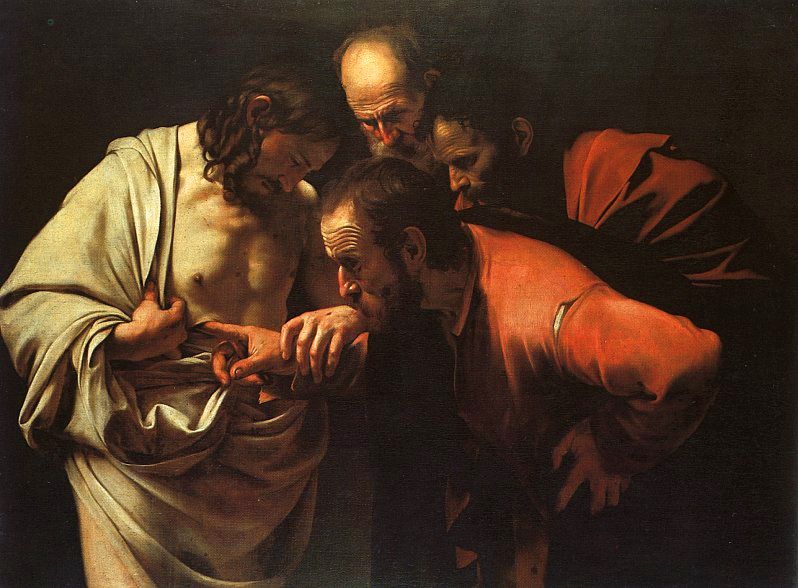
Two Thomases - the 2nd Sunday of Easter


(Gospel Reading: John 20.19–31)


“The man of faith who has never experienced doubt is not a man of faith.”

This is a tale of two Thomases. “Doubting Thomas” is the way one of the disciples in today’s Gospel reading is often unjustly described – as if we think we can write him off for his temerity in questioning the disciples’ account of their Easter meeting with Jesus. The other Thomas is the man who wrote those words with which I began: “The man of faith who has never experienced doubt is not a man of faith.”

This Thomas is a writer I’ve kept going back to throughout the time I’ve been ordained - over 30 years. Thomas Merton was one of the great Christian writers of the 20th century. Like many people, I first encountered his work in his book “The Seven Storey Mountain.” It’s the account of his vocation – from his childhood upbringing in France and England, through the loss of both his parents, his move to America, and his coming to faith... which led him to become a Trappist monk. He realised, as he says in his book, that his vocation – any Christian’s vocation - was to be a saint, and the book ends on a high note with a great confession of faith and his profession into monastic vows. It’s a tremendous book of 400 pages telling how God has been there all along, seeking him out and calling him on his journey of faith.

But what becomes still more interesting is to see how he went on from that high point. Could he continue living at that level of faith and confidence? There’s a lot to learn from reading his personal journals. Just a few years after the runaway success of “The Seven Storey Mountain”, he finds himself correcting the proofs of the book’s translation into French. It had become one of the religious bestsellers of all time, but he admits that now the book leaves him quite cold – he is no longer the man who wrote that book. Or rather, we might say, he’d moved on. Faith cannot remain static, so a faith which is full of confidence will – if it’s going to be a living faith – have to be challenged, even questioned and doubted.

“The Seven Storey Mountain” remains a classic of Christian spirituality. But it didn’t deal with those parts of Merton’s life that his superiors thought unedifying. A rather wayward year as an undergraduate in Cambridge, for example. And it’s never been established whether during that year he had fathered a child with whom he then had no further contact, a child later killed with its Mother during the Blitz. Whatever the truth behind all the speculation, we know that beneath his desire for holiness, and the zealous faith of his best-selling book, there were private doubts, anxieties, questioning and griefs.

And this is something that comes out clearly for the first time with the publishing of his personal journals. Having renounced the world, taken his vows in a silent order, after getting special permission to live in his own hermitage in the woods, Merton at the age of 50 had to have surgery on his spine which required that he leave the monastery. The operation was a success, and he returned to the abbey just in time for Easter – only for it to dawn upon him in the days that followed that he had fallen in love. It was a student nurse who had cared for him only briefly, but his feelings forced him to conclude, “I will do the only thing possible and risk loving with Christ’s love when there is so obvious a need for it.” He knows that his vows and his security in the religious life require him to break off his contact with the nurse. But everything he felt he had under control is now called into question. Recklessly he calls her from the monastery and arranges meetings with her – and knowing their feelings for each other, he comes to understand himself the more deeply. As he writes in his Journal: “One of the good sane things about this love is seeing myself as I am loved by M. True, she idealizes me impossibly, yet at the same time I am unavoidably known to her as I am. Many of the things she loves in me are things I find humiliating and impossible, but she loves them because they are concretely mine. I love her the same way....”

In a sense it is a hopeless love affair. It’s not something Merton can continue while maintaining the integrity of his vows - nor in fairness to the young woman. But it’s also something deeply moving, something that enables him more than anything in the last years of his life to grow – and that finally allows him to make sense of his vocation.

I tell the story because it shows that faith is not something we can insist upon. We cannot impose our faith upon other people, and we cannot maintain it for ourselves simply by keeping the rules. We can only live out the life of faith by recognising our humanity, by allowing questions and doubts to reach our hearts and minds – and above all by letting love do its work. In the end for Merton there is no conflict between his monastic vocation and the call to love – and to love with all his human being. Because when he is able to accept finally that someone else is loving him as the person he is – rather than as a monk, a priest or a writer – he comes to understand truly what love is.

It’s a lesson which has had to be learned over and over again from the earliest of times by anyone who would be a follower of Christ. The apostle Thomas is not someone to be condemned for his failure to believe that Christ was risen from the dead. Perhaps he was a man of stubbornness, someone who just wouldn’t take other people at their word – he tells us that much himself: “Unless I see.... I will not believe.” But can we not feel for him too? The other disciples have a message they can proclaim with boldness, because they have seen for themselves that first Easter day, when Jesus had come to them through the locked doors. But he had missed it – how is Thomas ever to be able to join with the other apostles in proclaiming their message of the Resurrection when he hasn’t seen it the same way they have?

And I want to ask, isn’t there a message for us all here, when we are trying to bear witness to the faith which keeps us going? We need to be confident in our faith, but we need to see that our experience is not necessarily that of other people. What is convincing to us may mean nothing to other people. Have they been there with us in our experience? Have we gone through the same experiences as them?

Of course St. John’s Gospel gives us a “happy ending” for Thomas despite all his questioning when Jesus comes a week later to stand again in the midst of the disciples. But what strikes me is that though Jesus shows the wounds in his hands and side to Thomas and invites him to touch them, we’re not told that Thomas does in fact do so. “My Lord and my God!” says Thomas to Jesus, but there is no longer the need for him to have tangible proof. “Blessed are those who have not seen and yet have come to believe,” says Jesus. And the truth of Thomas’s conversion is not that he can now reach out and touch the wounds of the risen Christ, but that the risen Christ has reached out and touched him. Jesus comes to Thomas with all his doubts and questions. He lets him ask, he allows for his anxieties, and still he calls him his disciple. Failure to believe is not grounds for condemnation. And the way to faith for Thomas is through the love of God in Christ in accepting him in all the frailty of his humanity.

The other Thomas – Thomas Merton – had embarked upon his Christian journey and his monastic vocation with the highest of goals, but was to discover the true meaning of love only when he found someone who loved him outside the rules and boundaries he’d set himself, someone who loved him as and for himself. That’s the way that God loves us, and the way he calls us into a community where we love one another. As Merton records: “I dreamt I was telling several other monks, ‘I shall be a saint’, and they did not seem to question me. Furthermore, I believed it myself. If I do – I shall – it will be because of the prayers of other people who, though they are better than I am, still want me to pray for them.”

Sunday, 8 April 2012

Christ is risen

He is risen indeed! Alleluia!

A time to shine the lamps and acknowledge the light...

Sunday, 24 April 2011

Christ is Risen!


We've had an excellent Holy Week and Easter Day at St. Cuthbert's. Thanks to so many people who made it all possible, not least the folk who put in much hard work behind the scenes - and there's a lot of scene-shifting as the church itself changes its appearance and character in our journey through Holy Week.

Recently I've been finding problems with the website which hosts our Parish Magazine and Sermons. So - thanks to my older son, Adam, who  knows about these things - I'm trying a different hosting solution. I'll place links to various items on a new page of this blog which you can access further up this page. Click and you should reach the document you want. For a start here are some direct links just uploaded:

The April 2011 issue of our Parish Magazine

The May 2011 issue of our Parish Magazine (this hasn't actually reached the printer yet, but will hopefully be appearing this week; meanwhile you can view it here first)

My Homily for today - Easter Day 24 April

And may we all know the joy and peace of Easter-tide!