Showing posts with label humanity. Show all posts

Sunday, 10 February 2013

Transfigured humanity - glory in weakness


Here’s a verse from today’s Gospel reading (Luke 9.28-36):

Peter and his companions were weighed down with sleep; but since they had stayed awake, they saw his glory and the two men who stood with him.  

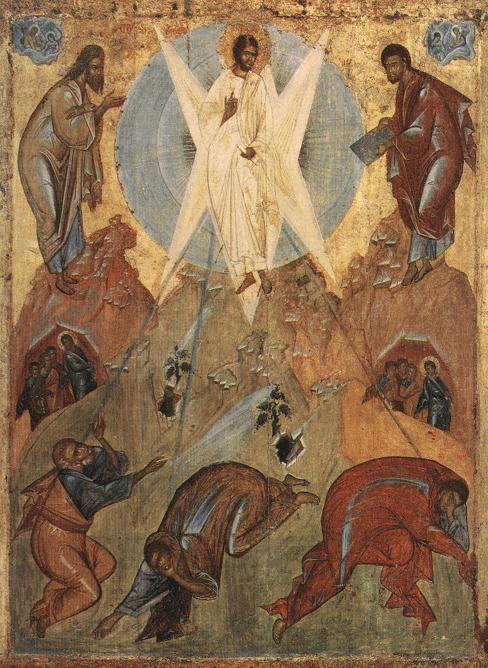
It’s only St. Luke who tells us that when the disciples went up a hill for the purpose of prayer, they were really too tired to do the job. But while he is praying, Jesus is transfigured in their midst; the appearance of his face changes and his clothes become dazzling white, and Moses and Elijah appear to bear witness to the glory of God revealed in Christ.

 What do words like “transfigured” or “transfiguration” and “glory” mean to you? Writing in the second century, St. Irenaeus of Lyons declared:

The glory of God is a man fully alive.
 
You can see it in our Gospel reading. Not only Jesus, but Moses and Elijah also, appear before the disciples in “glory.” It’s a dazzling vision which contrasts with the state of the disciples, Peter, James and John. They are “weighed down with sleep.” They try to respond to the vision with that strange offer by Peter to build three dwellings - it’s an inadequate response, an attempt to deal with something beyond their understanding. St. Luke’s Gospel tells us: “Peter did not know what he had said.” It might make us think of our own inadequacy when we say that we are simply lost for words. And then the disciples find themselves reduced to terror as a cloud covers them. The cloud signifies the presence of God - and the disciples hear God speak: “This is my Son, my Chosen; listen to him.” When the disciples return down the Mount of the Transfiguration they are asked to heal a young boy - and they fail. Where is the effect of God’s glory on them?

We need to go back to those words of St. Irenaeus which I quoted: “The glory of God is a man fully alive.” That’s what we see in Jesus - the Son of God, but at the same time fully human. The glory of his Transfiguration is not something alien coming upon him. The Transfiguration of Christ reveals the true glory, the real nature of a man who some want to write off as “all too human.” Our humanity is a calling to share the glory of God. Our weakness is something to be transfigured. God can use us because we are human.

Glory is not something to escape into from our human condition. Glory is revealed because we are human with all the frailty and frustrations of being what we are. But we wrestle with the frailty and frustration. (Here) at St. Cuthbert’s this morning we can’t help but be conscious of the loss we share by the death of Ian Severs on Friday evening. I wonder what people who didn’t know Ian made of him when they first met him? They’d find him in a wheelchair. With his Parkinson’s the words didn’t always come out right, limbs didn’t always behave properly; and he’d lost a leg - and had an arm that was barely functioning. You needed to get to know Ian a bit to start to know the man - and to recognise just how important he’s been, not only to the members of his family, not only to his friends, but to us as a church, and more widely in showing what it is to be fully alive even in the most extreme conditions of physical weakness and disability. He was with us (here) in church at the Eucharist last Sunday. In the conversations I had with him during the last week he didn’t say that he’d been feeling unwell; he did say he’d had a positive outcome from his last hospital check-up - but mainly he was taken up with tackling problems of fabric we’re having at present in the church and the hall. Problems they are to us - but Ian’s approach was to sort them out.

 There’s much more we need to say about Ian - and to share with one another. His death is a grievous loss. But we see in his approach to prolonged illness an example of how to live. Where should he sit in church, he’d asked, when he couldn’t fit his wheelchair into a pew? For me it’s always been important that he should be at the front. Not just so he could join in the service better - but so he could show us what and who we are.

 “The glory of God is a man fully alive.” That doesn’t mean being fighting fit, intellectually brilliant or the funniest person around. It means being open to what God can do in us.

Today our Diocese of Durham is encouraging us to observe as “Giving Sunday.” It’s up to the parishes as to what they do with the occasion - and it’s not the best time of year, I think, to be trying a stewardship drive… to encourage people to put more money on the plate, or think about increasing  their standing order for the church, or review the Gift Aids they might use to make their giving more tax efficient. Of course we’d be delighted if you do all these things. But perhaps we need first to think of life as a gift - in all that we receive from God, in the extent of God’s mercy, in the generosity to which we are called as Christians to respond, in what we can give back. It’s a time to express gratitude. I and the Church Council need to say thank you to all of you who give to support the work of our church. I don’t need to say how much you should give. I realise that some people get concerned about what they can give. What I’d say now is that our giving is about recognising the gift we have already received. As to the extent of our giving, it’s a strange thing but people who are generous somehow find themselves able to go on being more and more generous. Love itself does not count the cost.

I’m pretty hopeless at thinking of how to conduct so-called “stewardship campaigns” to stimulate giving to the church - I’m not starting a campaign now. But when we’ve had them in the past (at St. Cuthbert’s), I’ve been glad for people who have been practical about what we needed to do and who were ready to take a lead. One of those people was Ian Severs. It was Ian  who was ready to get up in front of other people and tell them what we needed to be doing. He put into practice what we needed as an example. He was down to earth.

And that’s when we see that the “glory of God” is not something unworldly. It’s worked out in the here and now, within the limits of our human capability, but at the same time able to be transformed - transfigured.

For all we have received - in terms of wealth, health (and our weaknesses), material resources, and above all people who show us his grace at work, in whom his glory is revealed, thanks be to God!

Sunday, 14 August 2011

After the Riots - Humanity and the Divine Image + Matthew 15.10-28

My summer holidays so far this year have consisted of a week staying in London. I had a great time. The weather was good, there was lots to do, we’d found somewhere both comfortable and reasonably priced to stay. And the location worked well - not in the centre of town, but next to a Docklands Light Railway station, and the bus to Trafalgar Square went from just a couple of hundred yards away.

A few years ago it was one of the poorest parts of the city - Limehouse in East London. But there is a Marina now in the Limehouse Basin, swish apartment blocks, and each night as we went back to our accommodation we’d look up and see the lights of the Canada Tower at Canary Wharf, just a mile or so away. Yet nevertheless, it’s in Tower Hamlets, which is, I think, still the poorest borough in the country. I suspect that if I’d gone onto the other side of the main street running through Limehouse, I wouldn’t have had to look too far to find all the tell-tale signs of poverty and deprivation.

I didn’t get into that part of our neighbourhood, but we did explore the next-door community of Wapping and Shadwell. In the nineteenth century it was over-populated, prone to disease and even epidemics of cholera, its workers depended on employment in the London Docks, much of it casual, so they could never be assured of regular wages. It continued to be poor throughout the 20th Century. And in the 1930s it found itself at the heart of tensions which divided many communities in many cities, but which focused here in the Battle of Cable Street when Oswald Moseley and the Black Shirts stirred up racial hatred. I’ve seen an estimate that 300,000 people turned out to resist the march along Cable Street by Moseley’s Fascists, even though 10,000 police were on duty to try to clear the way for the march. We went to see a mural painted to commemorate the opposition shown to fascism amidst the violence of the times. It took some finding... Anti-Semitism was at the heart of Fascism in the 1930s. Now the Jewish community might have gone from the area, but it’s even more racially-mixed. And - I want to say - it’s all the better for that. One of the things that surprised me in my visit to London is that people there on the whole are friendly. People on the bus in Wapping and Shadwell spoke, asked where we were going, told us where we should get off. Walking in the streets, people stopped to ask us where we were going and gave directions - some of them were probably on their way back from the mosque. When we found the mural we were looking for, it was on a building next to a park. In the park there were women, fully-veiled with face-coverings, and another woman sun-bathing in a bikini. Multi-culuralism, mixed race communities, good humour, tolerance and the sun shone. It was a wonderful week.

So I have to be glad we didn’t go a week later… This last week has seen riots in London, Birmingham, Wolverhampton, Manchester and elsewhere that can only be described as lawless violence and inexcusable, opportunistic criminality. Whatever might have sparked them off in the first place, what kept them going was the realisation that if you create a big enough disturbance then you can have more or less free rein to do what you want and take what you want. So start a fire, attack the fire crews when they turn out to tackle it, and you tie up the police in protecting the fire-fighters while you can go and loot shops. That seems to be the basic tactic. I don’t really need to say anything about how you follow it through in robbery, violent confrontation, arson, attacks on defenceless individuals and even murder. We’ve heard the stories told so many times - and seen it all on our television screens…

Someone summed up the view of Britain (or more correctly England) which has come to prevail in the United States media: “A few weeks ago we were the land of royal weddings and Harry Potter, but now it’s all phone-hacking and riots in the street.” Perhaps that sums it up - but neither perspective tells the truth. The looting and violence have been in particular places for a limited time - and we can be thankful for a response by so many more people who have come out to do what they can to help clear up the mess. And the rosy glow of a feel-good film and a wonderful royal occasion mustn’t mask the disaffection and alienation which have gone deep in our society.

It has been said to me several times during the last week that in the past people might not have had the things they wanted or even needed, but they made do with what they had. That may be true. But I suspect that it’s also true that they didn’t have to live with so much wealth and conspicuous consumption on display but out of their reach. Not just the bankers who pay themselves what they want and then add in the bonuses as well. Not just the celebrities in their fabulous homes when they’re not on a round of exotic holidays. But the fact that prosperity these days has come to be seen as requiring economic growth - and that means more and more consumption. We might see people turning out on the street with brushes and shovels to clear up but society as a whole has become fundamentally acquisitive. The Archbishop of Canterbury has put his finger on the problem when he spoke in the House of Lords, saying that we need to educate people to be citizens, not consumers. In the past people made do when they didn’t have enough. But now it’s there for the taking. It’s in their face - the media can survive only if they advertise it; the “have”s are conspicuous in their consumption of it; and why should they have it when others are excluded from it?

Something has gone fundamentally wrong in society. I wondered if those who went on the rampage could have any sense of generosity? Does the concept of humanity mean anything to them? But then - when politicians and the media refer to a whole section of society as an “underclass” what are they saying about these people? - that they’re less than human? The ideal promoted by so many people with political power is to work for a society in which people have “opportunity” - but that suggests that while some may make the most of it other people are never going to succeed; so what should they do?

People who take to the streets to riot and loot succeed only in destroying their own communities. And that can only add to the tragedy of an already-divided society. If we’re to make anything relevant to this out of the first part of today’s Gospel, perhaps it’s these words of Jesus: it’s “what comes out… that defiles. For out of the heart come evil intentions, murder, adultery, fornication, theft, false witness, slander.” We all need to take a good look into our hearts - what do we find there? how do we let it form us as the people we are? what do our actions say about us?

And then there’s that encounter of Jesus and the Canaanite woman. It happens in the region of Tyre and Sidon - so it’s outside the area inhabited by the Jews. But the Canaanites had lived exactly where the Jews were then living - the people of Israel had entered the land of Canaan and taken it by conquest. So in a sense she’s a displaced and alienated person. And when she comes to Jesus asking for the healing of her daughter, he seems to respond in terms which make the divisions between them all the more graphic: “It is not fair to take the children’s food and throw it to the dogs.”

What do we think of other people? What do we think of their needs and aspirations? Do we see what they lack rather than what they are? - human beings made in the image of God.

This last week has seen just too much failure in humanity. Where do we want to draw the line? - not merely in terms of acceptable behaviour but in seeing people as God sees them. Jesus may start by saying that he is sent to work only amongst his own people, the Israelites. But even then he speaks of them as a lost people. We are all lost, we all need to be found and rescued. And it’s the Canaanite woman - from an alien society - who shows what faith truly is. She looks beyond the division of Jew and Gentile and argues her case. She shows what is necessary for the healing of her daughter.

We need the healing of our broken, impoverished society. As Christians we look to God who shows how he takes humanity seriously by sending his Son into the world in human flesh. Perhaps we can take a lead by being more human where we are - and displaying something of the divine image to which we are called.

 
Preached on 14 August 2011 in St. Cuthbert's Church, Shotley Bridge

Thursday, 11 August 2011

One of this morning's Psalms - an appropriate meditation for our times

Psalm 15

1 Lord, who may dwell in your tabernacle? •
Who may rest upon your holy hill?

2 Whoever leads an uncorrupt life •
and does the thing that is right;

3 Who speaks the truth from the heart •
and bears no deceit on the tongue;

4 Who does no evil to a friend •
and pours no scorn on a neighbour;

5 In whose sight the wicked are not esteemed, •
but who honours those who fear the Lord.

6 Whoever has sworn to a neighbour •
and never goes back on that word;

7 Who does not lend money in hope of gain, •
nor takes a bribe against the innocent;

8 Whoever does these things •
shall never fall.

Lord, lead us to our heavenly home
by single steps of self-restraint
and deeds of righteousness;
through the grace of Jesus Christ our Lord.

Monday, 21 February 2011

Turning the other cheek - going that extra mile...

Yesterday we celebrated the 3rd Sunday before Lent. Because of the way the Church's Calendar is worked out it was the first time we've done so in "Year A" since the present Lectionary came out in 1998. Hope I got that right! - my point is that more often than not, we miss a critical piece of Jesus' teaching from the Sermon on the Mount as to how people should relate to one another. The Gospel reading was Matthew 5.38-48. It's required reading if we're to do anything about making relationships healthy. Why do we read it so seldom?

I wonder if as a society we've become over-influenced by soap opera, where the story-line is driven by the deliberate creation of misunderstanding. People don't hear what other people are saying - and they don't hang around to listen again or work out what was really intended. Are we any better? The whole of my homily is to be found by clicking here. And this is an excerpt:


... I suspect that many people think I’m supposed to go around “liking” everyone. The Vicar should go about with a smile on his face, spreading goodwill, never taking offence, being agreeable to all. When adverts appear in the Church Times from parishes seeking a new priest, quite commonly they say that he or she should have a good sense of humour. What they rarely say is “should have a good sense of humour, because you’re going to need it!” Maybe they could say “should have a back like the proverbial duck, so that the water and any other mess that occasionally comes your way can readily flow off it.” But actually that’s not what you need - because that would suggest that you’re rather impervious, hardened-up or deaf to what people say. And priests need to be vulnerable - so they can be easily wounded.

If that’s true of clergy, it’s true of lay people too - ordinary Christians trying to get on with lives of loving service. And that’s what today’s Gospel reading is about…

It’s part of the Sermon on the Mount, and in the section we read today you may hear an echo of the Beatitudes with which Jesus begins this so-called sermon:

Blessed are you when people revile you and persecute you and utter all kinds of evil against you falsely on my account. Rejoice and be glad, for your reward is great in heaven, for in the same way they persecuted the prophets who were before you.

Now Jesus turns his attention to the person who lashes out at you - “strikes you on the right cheek.” It needn’t be physical hurt that’s inflicted - what people say can be even worse. And what do you do about people who always seem to be wanting from you - and never giving - whether it’s wanting something that’s rightfully yours, dragging you along to do something you just don’t feel up to, or borrowing yet again when they could easily go out and buy whatever it is they need for themselves.

Does it ring a bell for you?

When we can’t think of an answer to give, then we can start to feel guilty - and it’s all quite irrational! When we feel that I’ve really done my best and people can’t see it, then we feel hurt. When we feel we’ve just got nothing more to give, then we rightly wonder when someone’s going to give something to me…

What we find in today’s Gospel reading is that those feelings about which we may feel so guilty are nothing new. A first step in facing up to them is simply to admit how I feel.

I’m glad to say that I find myself in a community where there’s lots of support and friendship. We should really value what we have here in this church, this parish, these villages in which we live. Love is the calling of the Christian - that’s what we need, and that’s what we need to share. “Love your neighbour as yourself.” The words are in today’s Old Testament reading - on the lips of Moses as the Israelites wandered all that time in the desert, 3,000 years and more ago. “Love your neighbour…” becomes the second great command of Jesus. But remember to love your neighbour as yourself. We need a sense of self-worth if we’re to do the loving properly. We need to be free of hurt, pain and guilt. But because we’re human there are those times when people cause us hurt - and times when we wound other people too. Admit how we feel, and we’ll get a better sense of our own need, our own worth, and how we can respond.

Jesus tells his disciples, “Love your enemies.” That’s tough, but I wonder if the first step is when we have to recognise who we are setting up to be our enemy? When we pray for those we dislike, there are different things to be doing. We have to ask if there is anyone in the first place that we really do dislike; then to ask why; then to explore whether that’s a real cause for feeling that way. Then as we pray we recognise their humanity - and our own. How does our humanity relate to what the Bible tells us about our being made in the image and likeness of God?...