Showing posts with label love. Show all posts

Monday, 14 October 2013

Vulnerability, defensiveness and love


There are many reasons why people put off going to the Doctor’s. “I’ll probably be better by the time I get an appointment,” you might say hopefully. Or there are the questions the doctor is going to ask about how you’ve been looking after yourself: just how much exercise do you take? – have you given up smoking yet? – what’s your diet like? – how many units of alcohol are you consuming every week?... and many more potentially embarrassing questions - and you wonder just what you’re going to have to have to admit to.

And then there’s the fear of what the doctor is actually going to do to you. Which bits is he/she going to prod and feel? What am I going to have to reveal of an anatomy of which I’m less than proud? And after all that, what might the treatment involve? – alright if it’s a course of antibiotics, but what about hospital referrals, long courses of drug therapy, operations, the bits which might be unlovely but which we don’t want to live without? 

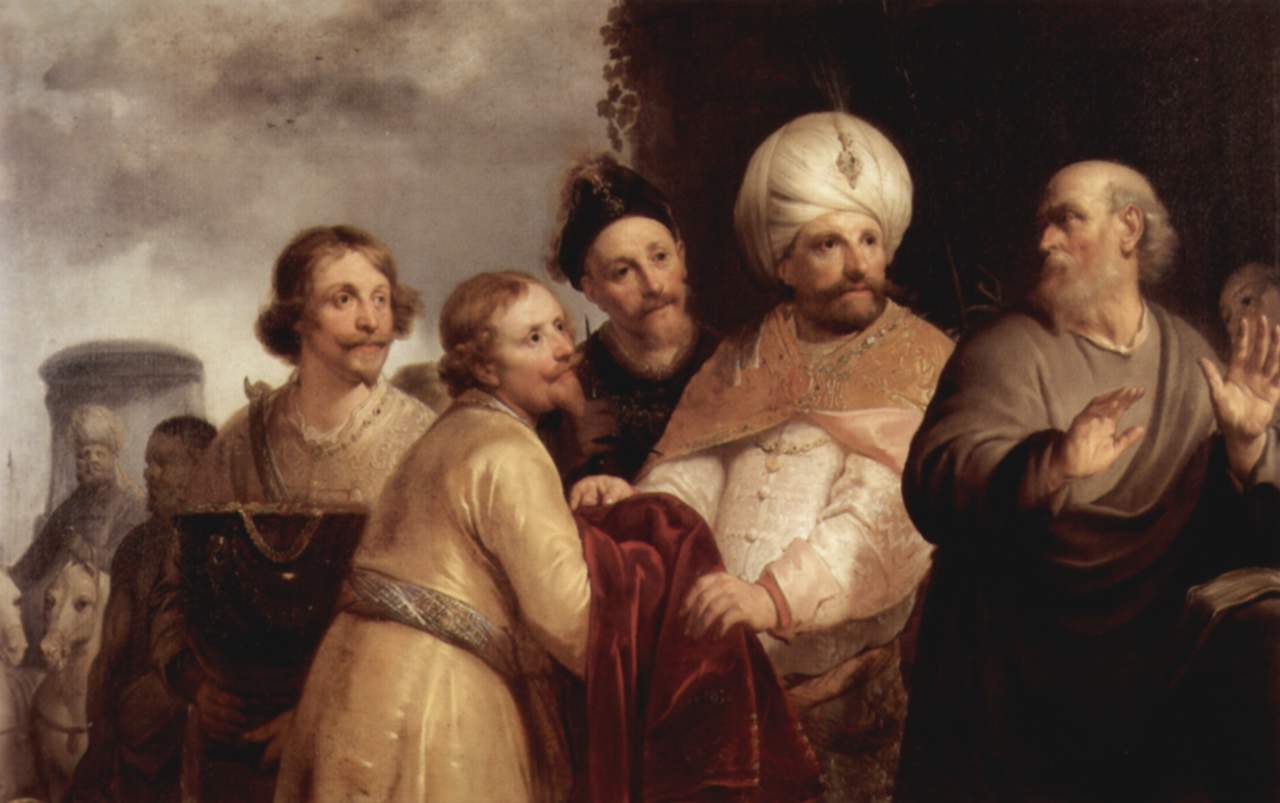
 Now try to think what might be in the mind of Naaman, the commander of the armies of Aram (modern day Syria) as he looks for a cure for his leprosy. It wasn’t newly diagnosed,… it was something he seems to have lived with for a long time. He’s a high-ranking General - despite his illness. He’s learned to live with the disease – and perhaps we need to be reminded that what the Bible calls leprosy is not necessarily what we call leprosy (Hanson’s Disease), but was a catch-all term for a number of skin disorders. How many doctors had he seen in his own country, how much indignity had he been put through? – all to no avail, as he continued to suffer a disfiguring condition which didn’t sit at all well with his public prominence.

Naaman seems to have given up hope of a cure. Why should he want to put himself through any more prodding or lay himself open to any more useless courses of treatment? The suggestion that he turns to the prophet who lives in Israel is a last chance for him, an alternative therapy of which he seems highly sceptical.

Naaman goes seeking his cure in the way a General would. He takes his dignity along with him in a big way: piles of silver, loads of gold, fine clothes and a letter from his king – this is the reward for the man who can heal him. But a man who can arrive in this fashion is also a threat. The King of Israel sees the horses and chariots which accompany Naaman: “Now we’re in trouble,” he says. “There’s no hope of a cure. The doctors have never been able to do anything for him. He’s obviously just picking a fight!”

But what Naaman needs is not what kings and generals expect. He goes on to the house of Elisha the prophet, and finds someone quite different from the physician to the royal court he might have expected. He parks his chariots outside Elisha’s house, but the prophet doesn’t even come out. No fussing over this man so concerned for his dignity! And while Elisha saves him from the prodding and probing of a doctor, his remedy is not at all what he wants to hear… “Go and bathe in the River Jordan – and do it seven times!” Has Naaman really come all this way to hear this? If Elisha is so great a prophet, he ought to come out and wave his arms around and cure him! He ought to give heed to Naaman’s important position! If bathing is involved, it shouldn’t be in that excuse for a river, the Jordan, but in one of the mightier rivers of Syria – perhaps it’s as though Naaman had come from Gstaad and been told to take the waters at the Spa in Shotley Bridge! Anyway, no doubt Naaman has tried all that sort of thing before!

Naaman storms off in a rage… Fortunately his servants calm him down. “OK,” they say, “he’s asked something pretty pathetic. But you’d have done it if he’d asked you to do something really difficult. Why not give it a go?” And they persuade him. He swallows his pride, goes to the river Jordan, washes in it seven times, and he is healed.

On one level, the message is that Naaman must recognise that Elisha speaks with the authority of the one true God. And he does! – when he goes home, he takes a trunk-load of Israelite earth with him, so he can worship on  the soil of the land promised by God to the Israelites. But there is another level, I think. Naaman’s first need is to recognise that he doesn’t have all the answers. The solution doesn’t lie in being able to throw your weight around. Horses and chariots might win you battles, but they can’t win you your health. Fine clothes may cover up disfigurement, but they don’t cure it. And heaps of money in the end serve only to show you what can’t be bought.

For Naaman, the need is to find humility: to acknowledge his need; instead of issuing his own commands, to listen to others. And finally to give up standing on his dignity. He goes to the river Jordan – and we can imagine the scene: first he has to unburden himself of the warrior’s armour and weapons; then to take off the fine clothes of status; and finally, as he stands naked by the river, to reveal what needs to be healed – not merely a physical condition, but his defensiveness, aggression, his pride.

Naaman cannot find healing as the rich general of mighty armies, but only as a man. Today’s Gospel story tells us something more. Ten lepers come to Jesus for healing. These men are outcasts, forced to live outside the village, careful to keep their distance from this religious teacher. They have no wealth, nothing to offer Jesus.  All they can say is “Jesus… have mercy on us!”  These are men who have nothing, except the hope that Jesus will do something for them – and whatever it is, they cannot buy it, nor can they expect religion to do anything for them, because their disease has turned them into people who are to be avoided by the religiously upright.

The strange thing is that Jesus doesn’t say yes or no to their request for healing. He just tells them to go and show themselves to the priests. It’s their response of faith that makes them well. St. Luke’s Gospel tells us, “as they went, they were made clean.” In St. Mark’s version of the story, it’s the touch of Jesus that heals the leper. For St. Luke, it’s a matter of hearing what Jesus has to say to us. Do we listen to what he is saying? Are we ready to hear and to act?

We don’t know what happens to most of the ten lepers who are healed, but one of them turns back, praising God and throws himself at Jesus’ feet in thanksgiving. The point that St. Luke’s Gospel makes is that the other nine don’t go back. And it’s a very modern and relevant point for our society where gratitude seems to be a scarce commodity. How often we complain, how rarely we give thanks! If only we were ready to show gratitude more often, then perhaps we would recognise just how many blessings we have received.

In this short episode, we see what is at the heart of the Christian Gospel – what we mean when we talk of the Incarnation, of God’s Son taking human flesh. Jesus knows what it is to be human. He knows what it is to be misunderstood and vulnerable. Jesus comes to us and shares in all that we are. He brings healing, he transforms lives, and he does it not by throwing his spiritual weight and power around, but by entering into all that needs to be healed. Jesus comes as the “wounded healer.” Not someone with the answer to everything, but one who can bring hope in our suffering because he knows what it is we suffer – sharing in our humanity, even in the uncleanness of the leper, he knows what it is that needs to be healed.

Do we know our need of healing – our need of God? Honesty with ourselves is one of the hardest things to achieve, which is why it is a good idea to be able to open ourselves up to someone else: a spiritual director, a member of our family, a friend.... And we can make a start by acknowledging our vulnerability, as finally Naaman  must do. To stop covering up. To see that for all our ability, wealth and achievements we can’t get it all sorted on our own. And this may help us help others in their need. So we don’t see them simply as people who are the authors of their own misfortune, people who deserve what they’ve got, people we can do without - like the folk of Jesus’ time thought they could do without the people they categorised as “unclean,” like so many people of his time despised the Samaritans, like the many prejudices we find voiced around us and perhaps share ourselves. “People are not loved because they are beautiful; they are beautiful because they are loved.” It’s love in action which Jesus brings to those who have less than nothing to offer. And when we feel unlovely, we do well to learn from this saying – and know that we are loved. And for that, be thankful…
 
(see - 2 Kings 5.1-3,7-15b; 2 Timothy 2.8-15; Luke 17.11-19)
 

Sunday, 7 April 2013

Two Thomases - the 2nd Sunday of Easter


(Gospel Reading: John 20.19–31)


“The man of faith who has never experienced doubt is not a man of faith.”

This is a tale of two Thomases. “Doubting Thomas” is the way one of the disciples in today’s Gospel reading is often unjustly described – as if we think we can write him off for his temerity in questioning the disciples’ account of their Easter meeting with Jesus. The other Thomas is the man who wrote those words with which I began: “The man of faith who has never experienced doubt is not a man of faith.”

This Thomas is a writer I’ve kept going back to throughout the time I’ve been ordained - over 30 years. Thomas Merton was one of the great Christian writers of the 20th century. Like many people, I first encountered his work in his book “The Seven Storey Mountain.” It’s the account of his vocation – from his childhood upbringing in France and England, through the loss of both his parents, his move to America, and his coming to faith... which led him to become a Trappist monk. He realised, as he says in his book, that his vocation – any Christian’s vocation - was to be a saint, and the book ends on a high note with a great confession of faith and his profession into monastic vows. It’s a tremendous book of 400 pages telling how God has been there all along, seeking him out and calling him on his journey of faith.

But what becomes still more interesting is to see how he went on from that high point. Could he continue living at that level of faith and confidence? There’s a lot to learn from reading his personal journals. Just a few years after the runaway success of “The Seven Storey Mountain”, he finds himself correcting the proofs of the book’s translation into French. It had become one of the religious bestsellers of all time, but he admits that now the book leaves him quite cold – he is no longer the man who wrote that book. Or rather, we might say, he’d moved on. Faith cannot remain static, so a faith which is full of confidence will – if it’s going to be a living faith – have to be challenged, even questioned and doubted.

“The Seven Storey Mountain” remains a classic of Christian spirituality. But it didn’t deal with those parts of Merton’s life that his superiors thought unedifying. A rather wayward year as an undergraduate in Cambridge, for example. And it’s never been established whether during that year he had fathered a child with whom he then had no further contact, a child later killed with its Mother during the Blitz. Whatever the truth behind all the speculation, we know that beneath his desire for holiness, and the zealous faith of his best-selling book, there were private doubts, anxieties, questioning and griefs.

And this is something that comes out clearly for the first time with the publishing of his personal journals. Having renounced the world, taken his vows in a silent order, after getting special permission to live in his own hermitage in the woods, Merton at the age of 50 had to have surgery on his spine which required that he leave the monastery. The operation was a success, and he returned to the abbey just in time for Easter – only for it to dawn upon him in the days that followed that he had fallen in love. It was a student nurse who had cared for him only briefly, but his feelings forced him to conclude, “I will do the only thing possible and risk loving with Christ’s love when there is so obvious a need for it.” He knows that his vows and his security in the religious life require him to break off his contact with the nurse. But everything he felt he had under control is now called into question. Recklessly he calls her from the monastery and arranges meetings with her – and knowing their feelings for each other, he comes to understand himself the more deeply. As he writes in his Journal: “One of the good sane things about this love is seeing myself as I am loved by M. True, she idealizes me impossibly, yet at the same time I am unavoidably known to her as I am. Many of the things she loves in me are things I find humiliating and impossible, but she loves them because they are concretely mine. I love her the same way....”

In a sense it is a hopeless love affair. It’s not something Merton can continue while maintaining the integrity of his vows - nor in fairness to the young woman. But it’s also something deeply moving, something that enables him more than anything in the last years of his life to grow – and that finally allows him to make sense of his vocation.

I tell the story because it shows that faith is not something we can insist upon. We cannot impose our faith upon other people, and we cannot maintain it for ourselves simply by keeping the rules. We can only live out the life of faith by recognising our humanity, by allowing questions and doubts to reach our hearts and minds – and above all by letting love do its work. In the end for Merton there is no conflict between his monastic vocation and the call to love – and to love with all his human being. Because when he is able to accept finally that someone else is loving him as the person he is – rather than as a monk, a priest or a writer – he comes to understand truly what love is.

It’s a lesson which has had to be learned over and over again from the earliest of times by anyone who would be a follower of Christ. The apostle Thomas is not someone to be condemned for his failure to believe that Christ was risen from the dead. Perhaps he was a man of stubbornness, someone who just wouldn’t take other people at their word – he tells us that much himself: “Unless I see.... I will not believe.” But can we not feel for him too? The other disciples have a message they can proclaim with boldness, because they have seen for themselves that first Easter day, when Jesus had come to them through the locked doors. But he had missed it – how is Thomas ever to be able to join with the other apostles in proclaiming their message of the Resurrection when he hasn’t seen it the same way they have?

And I want to ask, isn’t there a message for us all here, when we are trying to bear witness to the faith which keeps us going? We need to be confident in our faith, but we need to see that our experience is not necessarily that of other people. What is convincing to us may mean nothing to other people. Have they been there with us in our experience? Have we gone through the same experiences as them?

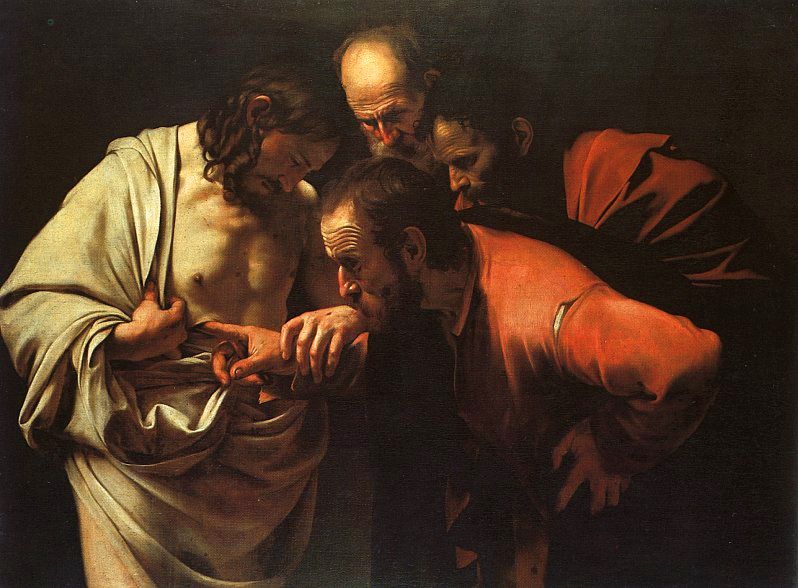
Of course St. John’s Gospel gives us a “happy ending” for Thomas despite all his questioning when Jesus comes a week later to stand again in the midst of the disciples. But what strikes me is that though Jesus shows the wounds in his hands and side to Thomas and invites him to touch them, we’re not told that Thomas does in fact do so. “My Lord and my God!” says Thomas to Jesus, but there is no longer the need for him to have tangible proof. “Blessed are those who have not seen and yet have come to believe,” says Jesus. And the truth of Thomas’s conversion is not that he can now reach out and touch the wounds of the risen Christ, but that the risen Christ has reached out and touched him. Jesus comes to Thomas with all his doubts and questions. He lets him ask, he allows for his anxieties, and still he calls him his disciple. Failure to believe is not grounds for condemnation. And the way to faith for Thomas is through the love of God in Christ in accepting him in all the frailty of his humanity.

The other Thomas – Thomas Merton – had embarked upon his Christian journey and his monastic vocation with the highest of goals, but was to discover the true meaning of love only when he found someone who loved him outside the rules and boundaries he’d set himself, someone who loved him as and for himself. That’s the way that God loves us, and the way he calls us into a community where we love one another. As Merton records: “I dreamt I was telling several other monks, ‘I shall be a saint’, and they did not seem to question me. Furthermore, I believed it myself. If I do – I shall – it will be because of the prayers of other people who, though they are better than I am, still want me to pray for them.”

Wednesday, 7 September 2011

All you need is love...

... that's the theme running through last Sunday's sermon preached by our Reader, Rosie Junemann. I missed it, but it's well worth reading and you can find it here. Links to lots more recent homilies are bundled up together with online versions of the Parish Magazine on the dedicated page of this blog.


I took last weekend off following a reading week, but I was at home so I took the opportunity to go to Durham Cathedral. It has its own particular celebration of the Feast of the Translation of the Relics of St. Cuthbert - which happily falls that day, 4th September. The main Feast of St. Cuthbert is 20th March. The Translation relates to the burial of his body in his present grave after the building of the Cathedral and following centuries during which the monks of his community moved from place to place following their displacement from Lindisfarne by the Viking raids and invasion. It was all very well done (pilgrimage procession to the Feretory / shrine) of course and you can probably find the Succentor's excellent sermon on the Cathedral's website. He took as his starting point the British Museum's current exhibition of relics and reliquaries, Treasures of Heaven, which I was glad to see a few weeks ago. We didn't actually venerate any relics on Sunday. But we were certainly put in mind of the call to holiness and the example of those who have gone before us.


Meanwhile... life resumes in this parish, and I'm about to take on responsibility also for the Parish of St. John, Castleside. This coming weekend will be busy: Northumbria Historic Churches Trust Steeplechase on Saturday; St. Cuthbert's Art Exhibition on Saturday and Sunday; and on Sunday services here will be for the last time at 8a.m. and 10a.m. At 6.30p.m. I'll be licensed in Castleside. Thereafter (from 18 September), St. Cuthbert's Sunday Sung Eucharist will be move to 10.30a.m. - with an 8a.m. BCP Eucharist on second Sundays of the month. Hopefully people will cope with the changes which will allow me to preside at a 9a.m. Eucharist in Castleside - though I'm already thinking about the problems that ice and snow may bring...

Join us for any of these if you can - and keep us in your prayers.

Monday, 21 February 2011

Turning the other cheek - going that extra mile...

Yesterday we celebrated the 3rd Sunday before Lent. Because of the way the Church's Calendar is worked out it was the first time we've done so in "Year A" since the present Lectionary came out in 1998. Hope I got that right! - my point is that more often than not, we miss a critical piece of Jesus' teaching from the Sermon on the Mount as to how people should relate to one another. The Gospel reading was Matthew 5.38-48. It's required reading if we're to do anything about making relationships healthy. Why do we read it so seldom?

I wonder if as a society we've become over-influenced by soap opera, where the story-line is driven by the deliberate creation of misunderstanding. People don't hear what other people are saying - and they don't hang around to listen again or work out what was really intended. Are we any better? The whole of my homily is to be found by clicking here. And this is an excerpt:


... I suspect that many people think I’m supposed to go around “liking” everyone. The Vicar should go about with a smile on his face, spreading goodwill, never taking offence, being agreeable to all. When adverts appear in the Church Times from parishes seeking a new priest, quite commonly they say that he or she should have a good sense of humour. What they rarely say is “should have a good sense of humour, because you’re going to need it!” Maybe they could say “should have a back like the proverbial duck, so that the water and any other mess that occasionally comes your way can readily flow off it.” But actually that’s not what you need - because that would suggest that you’re rather impervious, hardened-up or deaf to what people say. And priests need to be vulnerable - so they can be easily wounded.

If that’s true of clergy, it’s true of lay people too - ordinary Christians trying to get on with lives of loving service. And that’s what today’s Gospel reading is about…

It’s part of the Sermon on the Mount, and in the section we read today you may hear an echo of the Beatitudes with which Jesus begins this so-called sermon:

Blessed are you when people revile you and persecute you and utter all kinds of evil against you falsely on my account. Rejoice and be glad, for your reward is great in heaven, for in the same way they persecuted the prophets who were before you.

Now Jesus turns his attention to the person who lashes out at you - “strikes you on the right cheek.” It needn’t be physical hurt that’s inflicted - what people say can be even worse. And what do you do about people who always seem to be wanting from you - and never giving - whether it’s wanting something that’s rightfully yours, dragging you along to do something you just don’t feel up to, or borrowing yet again when they could easily go out and buy whatever it is they need for themselves.

Does it ring a bell for you?

When we can’t think of an answer to give, then we can start to feel guilty - and it’s all quite irrational! When we feel that I’ve really done my best and people can’t see it, then we feel hurt. When we feel we’ve just got nothing more to give, then we rightly wonder when someone’s going to give something to me…

What we find in today’s Gospel reading is that those feelings about which we may feel so guilty are nothing new. A first step in facing up to them is simply to admit how I feel.

I’m glad to say that I find myself in a community where there’s lots of support and friendship. We should really value what we have here in this church, this parish, these villages in which we live. Love is the calling of the Christian - that’s what we need, and that’s what we need to share. “Love your neighbour as yourself.” The words are in today’s Old Testament reading - on the lips of Moses as the Israelites wandered all that time in the desert, 3,000 years and more ago. “Love your neighbour…” becomes the second great command of Jesus. But remember to love your neighbour as yourself. We need a sense of self-worth if we’re to do the loving properly. We need to be free of hurt, pain and guilt. But because we’re human there are those times when people cause us hurt - and times when we wound other people too. Admit how we feel, and we’ll get a better sense of our own need, our own worth, and how we can respond.

Jesus tells his disciples, “Love your enemies.” That’s tough, but I wonder if the first step is when we have to recognise who we are setting up to be our enemy? When we pray for those we dislike, there are different things to be doing. We have to ask if there is anyone in the first place that we really do dislike; then to ask why; then to explore whether that’s a real cause for feeling that way. Then as we pray we recognise their humanity - and our own. How does our humanity relate to what the Bible tells us about our being made in the image and likeness of God?...