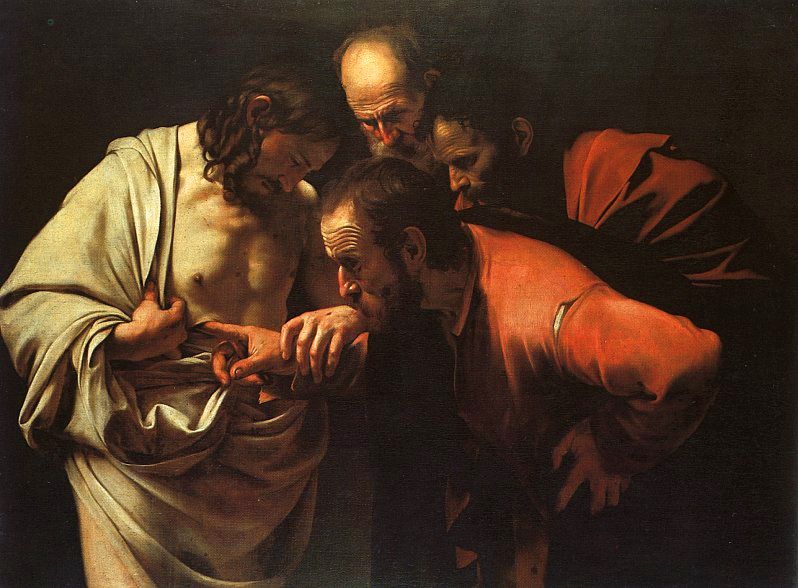
(Gospel Reading: John 20.19–31)
“The man of faith who has never
experienced doubt is not a man of faith.”
This is a tale of two Thomases. “Doubting Thomas” is the way one of the
disciples in today’s Gospel reading is often unjustly described – as if we
think we can write him off for his temerity in questioning the disciples’
account of their Easter meeting with Jesus. The other Thomas is the man who wrote those words with which I began:
“The man of faith who has never experienced doubt is not a man of faith.”
This Thomas is a writer I’ve kept going back to throughout the time I’ve
been ordained - over 30 years. Thomas
Merton was one of the great Christian writers of the 20th
century. Like many people, I first encountered his work in his book “The Seven
Storey Mountain.” It’s the account of his vocation – from his childhood
upbringing in France and England, through the loss of both his parents, his
move to America, and his coming to faith... which led him to become a Trappist
monk. He realised, as he says in his book, that his vocation – any Christian’s vocation - was to be a saint, and the book ends on a
high note with a great confession of faith and his profession into monastic
vows. It’s a tremendous book of 400 pages telling how God has been there all
along, seeking him out and calling him on his journey of faith.
But what becomes still more interesting
is to see how he went on from that
high point. Could he continue living at that level of faith and confidence? There’s
a lot to learn from reading his personal journals. Just a few years after the
runaway success of “The Seven Storey Mountain”, he finds himself correcting the
proofs of the book’s translation into French. It had become one of the
religious bestsellers of all time, but he admits that now the book leaves him
quite cold – he is no longer the man who wrote that book. Or rather, we might
say, he’d moved on. Faith cannot remain
static, so a faith which is full of confidence will – if it’s going to be a
living faith – have to be challenged, even questioned and doubted.
“The Seven Storey Mountain” remains a
classic of Christian spirituality. But it didn’t deal with those parts of
Merton’s life that his superiors thought unedifying. A rather wayward year as
an undergraduate in Cambridge, for example. And it’s never been established
whether during that year he had fathered a child with whom he then had no
further contact, a child later killed with its Mother during the Blitz.
Whatever the truth behind all the speculation, we know that beneath his desire
for holiness, and the zealous faith of his best-selling book, there were
private doubts, anxieties, questioning and griefs.
And this is something that comes out
clearly for the first time with the publishing of his personal journals. Having renounced the world, taken his vows in a
silent order, after getting special permission to live in his own hermitage in
the woods, Merton at the age of 50 had to have surgery on his spine which
required that he leave the monastery. The operation was a success, and he
returned to the abbey just in time for Easter – only for it to dawn upon him in
the days that followed that he had fallen in love. It was a student nurse who
had cared for him only briefly, but his feelings forced him to conclude, “I
will do the only thing possible and risk loving with Christ’s love when there
is so obvious a need for it.” He knows that his vows and his security in the
religious life require him to break off his contact with the nurse. But
everything he felt he had under control is now called into question. Recklessly
he calls her from the monastery and arranges meetings with her – and knowing
their feelings for each other, he comes to understand himself the more deeply. As he writes in his Journal: “One of the
good sane things about this love is seeing myself as I am loved by M. True, she
idealizes me impossibly, yet at the same time I am unavoidably known to her as I am. Many of the things she loves in
me are things I find humiliating and impossible, but she loves them because
they are concretely mine. I love her the same way....”
In a sense it is a hopeless love affair.
It’s not something Merton can continue while maintaining the integrity of his
vows - nor in fairness to the young woman. But it’s also something deeply
moving, something that enables him more than anything in the last years of his
life to grow – and that finally allows him to make sense of his vocation.
I tell the story because it shows that faith is not something we can insist upon.
We cannot impose our faith upon other people, and we cannot maintain it for
ourselves simply by keeping the rules. We can only live out the life of faith
by recognising our humanity, by allowing questions and doubts to reach our
hearts and minds – and above all by letting love do its work. In the end for
Merton there is no conflict between his monastic vocation and the call to love
– and to love with all his human
being. Because when he is able to accept finally that someone else is loving
him as the person he is – rather than
as a monk, a priest or a writer – he comes to understand truly what love is.
It’s a lesson which has had to be learned
over and over again from the earliest of times by anyone who would be a
follower of Christ. The apostle Thomas
is not someone to be condemned for his failure to believe that Christ was risen
from the dead. Perhaps he was a man of stubbornness, someone who just wouldn’t
take other people at their word – he tells us that much himself: “Unless I
see.... I will not believe.” But can we not feel for him too? The other
disciples have a message they can proclaim with boldness, because they have seen for themselves that first Easter day,
when Jesus had come to them through the locked doors. But he had missed it – how is Thomas ever to be
able to join with the other apostles in proclaiming their message of the
Resurrection when he hasn’t seen it the same way they have?
And I want to ask, isn’t there a message
for us all here, when we are trying to bear witness to the faith which keeps us
going? We need to be confident in our faith, but we need to see that our
experience is not necessarily that of other people. What is convincing to us may
mean nothing to other people. Have they been there with us in our experience?
Have we gone through the same experiences as them?
Of course St. John’s Gospel gives us a “happy
ending” for Thomas despite all his questioning when Jesus comes a week later to
stand again in the midst of the disciples. But what strikes me is that though
Jesus shows the wounds in his hands and side to Thomas and invites him to touch
them, we’re not told that Thomas does in
fact do so. “My Lord and my God!” says Thomas to Jesus, but there is no
longer the need for him to have tangible proof. “Blessed are those who have not
seen and yet have come to believe,” says Jesus. And the truth of Thomas’s
conversion is not that he can now reach out and touch the wounds of the risen
Christ, but that the risen Christ has reached out and touched him. Jesus comes to Thomas with all his
doubts and questions. He lets him ask, he allows for his anxieties, and still
he calls him his disciple. Failure to believe is not grounds for condemnation.
And the way to faith for Thomas is through the love of God in Christ in
accepting him in all the frailty of his humanity.
The other Thomas – Thomas Merton – had
embarked upon his Christian journey and his monastic vocation with the highest
of goals, but was to discover the true meaning of love only when he found
someone who loved him outside the
rules and boundaries he’d set himself, someone who loved him as and for himself. That’s the way that
God loves us, and the way he calls us
into a community where we love one another. As Merton records: “I dreamt I was
telling several other monks, ‘I shall be a saint’, and they did not seem to
question me. Furthermore, I believed it myself. If I do – I shall – it will be
because of the prayers of other people who, though they are better than I am,
still want me to pray for them.”