Sunday, 30 June 2013

Calling and following - Homily for 30 June 2013


(1 Kings 19.15-16, 19-21; Galatians 5.1, 13-25; Luke 9.51-62)

Jesus tells his would-be disciples, “Follow me!” And he doesn’t take any excuses. When one man says, “Let me go first and bury my father,” Jesus responds, “Let the dead bury their own dead…” Is that harsh? But I suspect that this man’s father had still to die, with plenty of life left in him. We do need to recognise family responsibilities, but not as simply another reason for saying why we’re not ready just yet for taking action.  There’s an urgency about Christ’s call, so much that Jesus tells the man who wants to go first and say goodbye to his family: “No one who puts a hand to the plough and looks back is fit for the kingdom of God.”
 
How do you respond to the call of Christ? How do you make any decisions? How do you balance responsibilities, commitments, vocation and calling and set them against the person you are? - and the person you could be?
 
These are all issues I’ve been pondering again recently. Partly because this weekend is the anniversary of my ordination - what do I make of my calling as priest and deacon 32 years after the event? But also in the light of my experience of facing surgery and then having it cancelled, re-scheduled and cancelled again - and then being asked when or even whether I wanted to go ahead with it. After I’d psyched myself up for several months and planned who was going to be affected by my taking time off for several weeks to follow - and after I’d eventually had eight hours waiting on the ward for the operation to take place, half that time feeling rather silly in a theatre gown and thigh-length surgical stockings - I do understand why it was all called off, but it’s no easier for that to contemplate going back again. So everything is off again for the next few months.
 
Meanwhile I’ve pondered - and lots of people have been talking to me about their experience of health issues. There are those who have found themselves at the mercy of unforeseen complications - someone who’d had an operation which should have taken 40 minutes but it had actually taken five and a half hours; surgeons can’t plan for that. And people who’d found there was no alternative. Most succinctly someone was telling me he’d only been in hospital once in his life: “They came and asked me to give my consent for the operation, so I asked them what would happen if I didn’t sign. To which they said, well… you’ll be dead within 24 hours.” He signed - and I’m glad to say is now in robust good health.
 
It makes it easier to make a decision when you know there’s no alternative.
 
But what about the choices you have? My experience is perhaps a bit like people who’ve been booked up for a hot-air balloon flight. They may be apprehensive, but they’re ready for it. But then the flight gets cancelled on the day because of weather conditions. So they book again - and it gets cancelled again. And then they’re running out of days when there’s any availability, and it’s inconvenient, and the weather might be wrong again. What is going to get them back in the basket?
 
Or yesterday I was watching people on a zip-wire over the Tyne, jumping off the top of the Baltic to fly across the river to end up on a scaffolding tower in the middle of a car park. Two of them were people I knew. “Look, he’s on the edge and he’s got his legs over the side,” the daughter of one of  them exclaimed. I can imagine that moment - looking down to the ground, looking out over the river, looking at that thin cable which is all that separates life and death, and thinking “why did I sign up to this?”
 
I’m glad to say they got safely across - and no regrets.
 
What will make us jump? The leap of faith isn’t just for a short flight in a harness with all the safety procedures in place. “Follow me,” says Jesus - and it will have implications for the way you live your life… for the rest of your life. So it’s not surprising that some of the people Jesus encounters make their excuses. “I will follow you, Lord; but let me first say farewell to those at my home.” And Jesus says, “No one who puts his hand to the plough and then looks back is fit for the kingdom of God.”
 
Can you plough that furrow? When people come to make arrangements for the Baptism of a child, do they see that it’s not just a half-hour service?.. It’s the beginning of a life-time, life-long project. “For freedom Christ has set us free,” St. Paul says in today’s New Testament reading. Paul isn’t always easy to understand. What he’s saying here is that living the Christian life isn’t just a matter of following rules - and it’s certainly not a matter of picking and choosing which rules to follow. There’s actually only one rule, “one commandment” - “You shall love your neighbour as yourself.” But that’s a rule to apply in every part of life and throughout your life. He warns us about all the things we shouldn’t do: avoid “fornication, impurity, licentiousness,  idolatry, sorcery, enmities, strife, jealousy, anger, quarrels, dissensions, factions,  envy, drunkenness, carousing, and things like these. I am warning you, as I warned you before: those who do such things will not inherit the kingdom of God.” But it can be still more difficult to do the things which are positive - and these are the things that are really necessary: “the fruit of the Spirit is love, joy, peace, patience, kindness, generosity, faithfulness, gentleness, and self-control... If we live by the Spirit, let us also be guided by the Spirit.”
 
The good news is that it’s not all down to our own efforts. Jesus calls us to follow, to set our hand to the plough - but it’s his Holy Spirit who will guide us and strengthen us.
 
I’m struck by the enormity of the calling - to set out and to keep going… that is what Christ asks of us. Over 30 years since my ordination I’m still working on it. I hope I’m getting there. And I want to end by saying that the most significant thing I have learned in all those years is that we don’t get there simply by our own efforts. Too long perhaps I’ve dwelt on an image like that of the man in the picture inside your pewsheet. How much effort he seems to be putting into the task of ploughing! You’d think he was pushing the plough himself. Well, he does need to keep his oxen going the right way, his is the responsibility of guiding the plough. But we need to remember in our case that it’s Christ who goes before us, and God who supplies us with the grace we need. We simply need to follow.


Friday, 28 June 2013

Bringing home the Gospel…


Old news makes good news - or rather in this case good news (the literal meaning of the word gospel) makes the news still today.

The Lindisfarne Gospels were produced over 1,300 years ago. But the news that they are returning for three months to the North East of England from whence they came has caught the public imagination. Throughout July, August and September it will be possible to see them in a special exhibition in the Palace Green Library between Durham Cathedral and the Castle.

The Gospels are just that - the setting down of the good news of Jesus as told by Matthew, Mark, Luke and John. Handwritten and wonderfully illustrated, it’s easy to see why this ancient book should appeal to people.

But I heard someone asking why we should be making so much of a fuss about them. Since Henry VIII pillaged the monasteries of their treasures in the 16th century, the Gospels have been in London. But in our times this has meant that millions of people have had the opportunity to see them - and free. “All you need to do is nip into the British Library - and there they are…” said my friend.

See them in Durham this summer - and you’ll have to pay! But it should be worth it. Here we’ll see not a book removed from its rightful home, but the Gospels set in their proper context. See them alongside the Durham Gospels and the Gospel which was buried in the grave of St. Cuthbert, and many other treasures besides. See the explanations of how they came to be produced and the community which created them. See that they have come home. And remember that the true treasure is the witness they bear to God’s love revealed for us in Jesus.

Durham Cathedral itself will be hosting events to celebrate the return of the Gospels. And - as you can read in this magazine - there are other exhibitions and occasions throughout the region to spread the celebration. I hope people might go to them. It’s a way of understanding that the Gospels come from a living tradition in which we share - of prayer, study, worship and service. They are an artistic production - and God gives us imaginations that we should keep using. They come from the North East - and that’s a reminder to us of the part which we can play in an often-neglected part of our country.

The Lindisfarne Gospels are a gift from our region to the wider world. What gifts can we still offer in our own day?                                  
 
Martin Jackson
 
This item appears in our Parish Magazine for July and August - read the whole issue online by clicking here

Monday, 3 June 2013

Only speak the word...


Trinity 1 (Proper 4) – Eucharist – 2.vi.2013

(1 Kings 8.22f, 41-43; Galatians 1.1-12; Luke 7.1b-10)

As far as I’m aware, this is the first time today’s readings have come up for use at the Eucharist since the present lectionary was introduced in 1998 - you need a combination of an early Easter and the right year in the three year-cycle by which the readings are organized if you’re going to get them. So take a good look - I don’t know when we’ll be seeing them next!

Because we don’t use them very much, you might not be very familiar with them. The first reading shows us Solomon, son of the great King David, at the dedication of the Temple which he has built in Jerusalem. Solomon can be rather full of himself. He’s a man of accomplishment. People come from far and wide to admire the buildings he’s put up - and to gawp at this wealth and riches. He’s renowned for his wisdom - though like many clever people he can also show quite a capacity for being stupid. And now we see him taking it upon himself to address God in prayer. “There is no God like you in heaven above or on earth beneath,” he acknowledges - but at the same time there’s a certain note of self-congratulation in his tone, a sort of “look at what I’ve built.” And then there’s the conclusion to his prayer - let people come from other nations to this place, and let them recognise who God is truly for them - “may they know your name and fear you… may they know that your name has been invoked on this house…”

If you visit Jerusalem now, you can’t help but be impressed by the size of the Temple Solomon built. Not that it is there for you to see - but the vast expanse of the site where once it stood... On the Temple Mount today you’ll find the El Aqsa Mosque and the Dome of the Rock - large, impressive buildings in themselves, but surrounded by still more empty space. The Temple which filled that space must have been immense. People who visited it must have been quite taken aback by its scale - as we know the disciples were by its smaller replacement when they exclaimed, “look at the size of the stones with which this place is built!”

Impressive buildings can have a certain converting effect - the Temples, churches and mosques which have stood on that holy site in Jerusalem; St. Peter’s Basilica in Rome: Hagia Sophia in Istanbul; our own Cathedral in Durham… These are places of prayer, places of pilgrimage, and they ask of us, “what does this place say about the God who is to be worshipped here?”

There isn’t a right answer to that question. The buildings which stand to glorify God were so often built to declare human power. Durham Cathedral stands alongside Durham Castle to remind us that the Norman king, William, truly was “the Conqueror.” It doesn’t stop them being holy places, but their very scale and expense begs the question of the cost at which they were built - wealth so often built up by unjustly acquired riches; human labour which was not always properly rewarded…

So I’m a bit ambivalent about the plea made in today’s Gospel reading by those who approach Jesus for a favour on behalf of a Roman officer. This centurion, say the people who have come to seek out Jesus, “is worthy of having you do this for him, for he loves our people, and it is he who built our synagogue.” I want to ask how the centurion found the money to pay for the synagogue - was it his to give? Or did he direct the labour of those who built it? - and were they fairly treated? And a still deeper question I have is in those words “He is worthy of having you do this for him…” What makes this man worthy? - the fact that he has the money at his disposal when others are poor? - the ability to tell people to get on with the job when others are only to do what they are told?

But here I need to stop griping. King Solomon at the dedication of the Temple might be over-impressed by his own wealth, power and supposed wisdom. But this Roman centurion is someone quite different. The people from the synagogue who come on his behalf do so because he counts himself anything but worthy to approach Jesus - and they know he is a true friend of God. The centurion is a man of truly human compassion. He wants healing not for himself but for a slave. As a man who has more wealth than most and people at his beck and call, you might expect that the illness of a mere slave would be the least of his concerns. But this is someone he cares for. In his telling of the story, St. Matthew’s Gospel tells us that the centurion goes to Jesus himself - he doesn’t say anything of what he has done to deserve special treatment; he can only ask. In St. Luke’s account, other people go on the centurion’s behalf - and they say what they say because they know the extent of his faith and love.

And we see more of that faith when he sends a further message, asking Jesus not to come to his house - simply, “speak the word, and let my servant be healed.” As a man of authority himself, the centurion recognises the authority of Jesus - a man of God who will do God’s work. As a man of faith, he believes in the one who can bring healing to his servant.

Do we believe it? Do we believe that God will answer our prayers? Do we believe that God will give us the healing we ask for?

Lord, do not trouble yourself, for I am not worthy to have you come under my roof; therefore I did not presume to come to you. But only speak the word, and let my servant be healed…

That’s what we say in response to the invitation to come to Communion in this Eucharist: “Lord, I am not worthy to receive you, but only say the word and I shall be healed.”

Jesus is the word who comes to us in the bread of the Eucharist, who gives us his Body and his Blood, for our salvation - for our healing. We need simply place ourselves before him, make our request, and he is there for us.

Not that we are worthy - but we can ask in faith.

This is how Bishop Tom Wright sums up what he has to say about today’s Gospel reading:

Contrast the prayer of this centurion with the prayers we all too often pray ourselves. ‘Lord,’ we say (not out loud, of course, but this is what we often think), ‘I might perhaps like you to do this… but I know you may not want to, or it might be too difficult, or perhaps impossible…’ and we go on our way puzzled, not sure whether we’ve really asked for something or not. Of course, sometimes we ask for something and the answer is No. God reserves the right to give that answer. But this story shows that we should have no hesitation in asking. Is Jesus the Lord of the world, or isn’t he?

Saturday, 25 May 2013

One reason a plasma screen in church might help this Sunday


With thanks to anglicanmemes.com

Tuesday, 23 April 2013

Of Sheep and Annual Meetings

Both our parishes held their Annual Parochial Church Meetings on Sunday. This Homily was intended as part of the "Chairman's Remarks" (as the agenda put it):


We’re still in Easter-tide, the season of Easter. But we’ve now run out of Resurrection appearances by Jesus for use in the Gospel reading. Last Sunday we had the final appearance recorded by St. John as Jesus came to the disciples by the Sea of Galilee - and his last instructions to the disciples… what they should do to live out their faith in the risen Christ when physically he has left them.

But there’s a link between last week’s Gospel reading and this week’s. They both involve sheep. Last week we heard Jesus ask Peter three times, “Do you love me?” And to Peter’s reply, Jesus answers: “Feed my lambs…” “Tend my sheep…” “Feed my sheep…” Love for Jesus is put into action by care for the flock.

Today we hear Jesus on an occasion in his earlier ministry and he says, “My sheep hear my voice.” But there’s also a problem - because he tells the people he is speaking to, “you do not believe, because you do not belong to my sheep.”

Who are the sheep? Who is in as far as the flock of Christ is concerned? - and who is out? And if Jesus says “Tend my sheep, feed my sheep…” does that mean there are people who don’t need his care or who don’t deserve it?

Today is observed by the Church as a whole as “Vocations Sunday” - a day to think about being called by God. It’s also the day when our parish has its Easter Vestry and Annual Parochial Church Meeting. And our Gospel reading has us think about sheep.

They’re all connected. It’s quite appropriate that all three coincide. A vocation is a calling to do something. It might be a job - and knowing that a particular job is just right for you, and you are just the person to do it. In the Church “vocation” has been particularly associated with a calling to the priesthood in particular - and more generally to other forms of ministry. We need to keep that definition in mind. We need to pray for more priests - and for the right people to test their vocations. That’s not just about the right person to do the job, it’s about the struggle to be the person God is calling. And when we understand this, then we see that really every Christian has a  vocation - every Christian is called to live out their faith on a daily basis, to be who and what God wants. Are we ready to ask each day what God wants of us? Do we seek to know where he is calling us? Do we want to be the people God wants us to be? If we think we are, does God recognise us?... those words of Jesus, “you do not belong to my sheep,” might seem quite judgmental - but they might also be a prompt to take a good look at ourselves and ask how God sees us.

And vocation is not merely something individual. God calls me - but the Church has its part to play in recognising it. That’s why we say that a vocation to the priesthood has to be “tested.” But not just priesthood. Today we have our church’s Annual Meeting. It’s a time to take note of reports on what we’ve been doing over the past year, to check the accounts, to vote for churchwardens and members of the PCC. But not just to look back or to do what is legally required of us. Today’s meeting invites us to ask how close we can come to fulfillment of our calling as God’s people - to be the  Body of Christ; to be a sign of his Kingdom. It’s not just that we are sheep - Christ’s flock who need looking after… We have a calling to look out for other people too - those who are outside the doors of our churches, those who need our help and care, people looking for faith, people who don’t even recognise their need.

Who are the “sheep?” The real question is “who is the shepherd?” Always we are called back to Christ - and when we are called we share in his care for the flock. But Jesus doesn’t only call himself a shepherd to his flock. He also calls himself “the door to the sheepfold.” He’s the way in. If we wonder who are the sheep he calls into his flock, the way forward is not to judge the answer for ourselves. It’s to see that we keep the door open for those who might come in.

There are some well-known words often used at the door of a church - and we might use them as a prayer for ourselves in our vocation and on this day of our Annual Meeting:

O God, make the door of this house
    wide enough to receive all who need human love and fellowship;
    narrow enough to shut out all envy, pride, and strife.

Make its threshold smooth enough
    to be no stumbling-block to children,
    nor to straying feet,
    but rugged enough to turn back the tempter’s power. 

God make the door of this house the gateway to your eternal kingdom.

Can we open our doors to all who are in need? Can we be faithful to our vocation as Christ’s people - and help other people recognise their calling?

“My sheep hear my voice. I know them, and they follow me,” says Jesus. On this Vocation Sunday the Church reminds us: "The young are called; the elderly are called. There is no retirement from the Christian pilgrimage. …... Women are called and men are called….. God 'has no favourites' …. We are all called no matter what our occupations may be. There is no special status in the Kingdom for those in 'top jobs' or 'important responsibilities' "   

May that be true for us! May we help other people find it is true for them!

Sunday, 7 April 2013

Two Thomases - the 2nd Sunday of Easter


(Gospel Reading: John 20.19–31)


“The man of faith who has never experienced doubt is not a man of faith.”

This is a tale of two Thomases. “Doubting Thomas” is the way one of the disciples in today’s Gospel reading is often unjustly described – as if we think we can write him off for his temerity in questioning the disciples’ account of their Easter meeting with Jesus. The other Thomas is the man who wrote those words with which I began: “The man of faith who has never experienced doubt is not a man of faith.”

This Thomas is a writer I’ve kept going back to throughout the time I’ve been ordained - over 30 years. Thomas Merton was one of the great Christian writers of the 20th century. Like many people, I first encountered his work in his book “The Seven Storey Mountain.” It’s the account of his vocation – from his childhood upbringing in France and England, through the loss of both his parents, his move to America, and his coming to faith... which led him to become a Trappist monk. He realised, as he says in his book, that his vocation – any Christian’s vocation - was to be a saint, and the book ends on a high note with a great confession of faith and his profession into monastic vows. It’s a tremendous book of 400 pages telling how God has been there all along, seeking him out and calling him on his journey of faith.

But what becomes still more interesting is to see how he went on from that high point. Could he continue living at that level of faith and confidence? There’s a lot to learn from reading his personal journals. Just a few years after the runaway success of “The Seven Storey Mountain”, he finds himself correcting the proofs of the book’s translation into French. It had become one of the religious bestsellers of all time, but he admits that now the book leaves him quite cold – he is no longer the man who wrote that book. Or rather, we might say, he’d moved on. Faith cannot remain static, so a faith which is full of confidence will – if it’s going to be a living faith – have to be challenged, even questioned and doubted.

“The Seven Storey Mountain” remains a classic of Christian spirituality. But it didn’t deal with those parts of Merton’s life that his superiors thought unedifying. A rather wayward year as an undergraduate in Cambridge, for example. And it’s never been established whether during that year he had fathered a child with whom he then had no further contact, a child later killed with its Mother during the Blitz. Whatever the truth behind all the speculation, we know that beneath his desire for holiness, and the zealous faith of his best-selling book, there were private doubts, anxieties, questioning and griefs.

And this is something that comes out clearly for the first time with the publishing of his personal journals. Having renounced the world, taken his vows in a silent order, after getting special permission to live in his own hermitage in the woods, Merton at the age of 50 had to have surgery on his spine which required that he leave the monastery. The operation was a success, and he returned to the abbey just in time for Easter – only for it to dawn upon him in the days that followed that he had fallen in love. It was a student nurse who had cared for him only briefly, but his feelings forced him to conclude, “I will do the only thing possible and risk loving with Christ’s love when there is so obvious a need for it.” He knows that his vows and his security in the religious life require him to break off his contact with the nurse. But everything he felt he had under control is now called into question. Recklessly he calls her from the monastery and arranges meetings with her – and knowing their feelings for each other, he comes to understand himself the more deeply. As he writes in his Journal: “One of the good sane things about this love is seeing myself as I am loved by M. True, she idealizes me impossibly, yet at the same time I am unavoidably known to her as I am. Many of the things she loves in me are things I find humiliating and impossible, but she loves them because they are concretely mine. I love her the same way....”

In a sense it is a hopeless love affair. It’s not something Merton can continue while maintaining the integrity of his vows - nor in fairness to the young woman. But it’s also something deeply moving, something that enables him more than anything in the last years of his life to grow – and that finally allows him to make sense of his vocation.

I tell the story because it shows that faith is not something we can insist upon. We cannot impose our faith upon other people, and we cannot maintain it for ourselves simply by keeping the rules. We can only live out the life of faith by recognising our humanity, by allowing questions and doubts to reach our hearts and minds – and above all by letting love do its work. In the end for Merton there is no conflict between his monastic vocation and the call to love – and to love with all his human being. Because when he is able to accept finally that someone else is loving him as the person he is – rather than as a monk, a priest or a writer – he comes to understand truly what love is.

It’s a lesson which has had to be learned over and over again from the earliest of times by anyone who would be a follower of Christ. The apostle Thomas is not someone to be condemned for his failure to believe that Christ was risen from the dead. Perhaps he was a man of stubbornness, someone who just wouldn’t take other people at their word – he tells us that much himself: “Unless I see.... I will not believe.” But can we not feel for him too? The other disciples have a message they can proclaim with boldness, because they have seen for themselves that first Easter day, when Jesus had come to them through the locked doors. But he had missed it – how is Thomas ever to be able to join with the other apostles in proclaiming their message of the Resurrection when he hasn’t seen it the same way they have?

And I want to ask, isn’t there a message for us all here, when we are trying to bear witness to the faith which keeps us going? We need to be confident in our faith, but we need to see that our experience is not necessarily that of other people. What is convincing to us may mean nothing to other people. Have they been there with us in our experience? Have we gone through the same experiences as them?

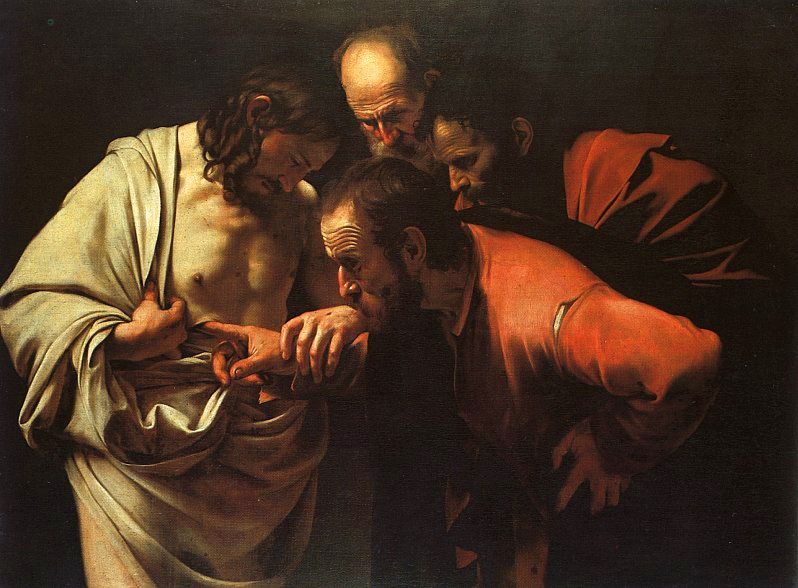
Of course St. John’s Gospel gives us a “happy ending” for Thomas despite all his questioning when Jesus comes a week later to stand again in the midst of the disciples. But what strikes me is that though Jesus shows the wounds in his hands and side to Thomas and invites him to touch them, we’re not told that Thomas does in fact do so. “My Lord and my God!” says Thomas to Jesus, but there is no longer the need for him to have tangible proof. “Blessed are those who have not seen and yet have come to believe,” says Jesus. And the truth of Thomas’s conversion is not that he can now reach out and touch the wounds of the risen Christ, but that the risen Christ has reached out and touched him. Jesus comes to Thomas with all his doubts and questions. He lets him ask, he allows for his anxieties, and still he calls him his disciple. Failure to believe is not grounds for condemnation. And the way to faith for Thomas is through the love of God in Christ in accepting him in all the frailty of his humanity.

The other Thomas – Thomas Merton – had embarked upon his Christian journey and his monastic vocation with the highest of goals, but was to discover the true meaning of love only when he found someone who loved him outside the rules and boundaries he’d set himself, someone who loved him as and for himself. That’s the way that God loves us, and the way he calls us into a community where we love one another. As Merton records: “I dreamt I was telling several other monks, ‘I shall be a saint’, and they did not seem to question me. Furthermore, I believed it myself. If I do – I shall – it will be because of the prayers of other people who, though they are better than I am, still want me to pray for them.”

Bonnets on parade

A wonderful display from Easter Day...


... and one of the models