With thanks to anglicanmemes.com
Saturday, 25 May 2013


Tuesday, 23 April 2013
Of Sheep and Annual Meetings
Both our parishes held their Annual Parochial Church Meetings on Sunday. This Homily was intended as part of the "Chairman's Remarks" (as the agenda put it):
We’re still in Easter-tide, the season of
Easter. But we’ve now run out of Resurrection appearances by Jesus for use in
the Gospel reading. Last Sunday we had the final appearance recorded by St.
John as Jesus came to the disciples by the Sea of Galilee - and his last
instructions to the disciples… what they should do to live out their faith in
the risen Christ when physically he has left them.
But there’s a link between last week’s
Gospel reading and this week’s. They both involve sheep. Last week we heard
Jesus ask Peter three times, “Do you love
me?” And to Peter’s reply, Jesus answers: “Feed my lambs…” “Tend my sheep…”
“Feed my sheep…” Love for Jesus is put into action by care for the flock.
Today we hear Jesus on an occasion in his
earlier ministry and he says, “My sheep hear my voice.” But there’s also a
problem - because he tells the people he is speaking to, “you do not believe,
because you do not belong to my
sheep.”
Who are the sheep? Who is in as far as the flock of Christ is
concerned? - and who is out? And if
Jesus says “Tend my sheep, feed my sheep…” does that mean there are people who
don’t need his care or who don’t deserve it?
Today is observed by the Church as a
whole as “Vocations Sunday” - a day to think about being called by God. It’s
also the day when our parish has its Easter Vestry and Annual Parochial Church
Meeting. And our Gospel reading has us think about sheep.
They’re all connected. It’s quite
appropriate that all three coincide. A vocation
is a calling to do something. It might be a job - and knowing that a particular
job is just right for you, and you are just the person to do it. In the Church
“vocation” has been particularly associated with a calling to the priesthood in
particular - and more generally to other forms of ministry. We need to keep
that definition in mind. We need to pray for more priests - and for the right
people to test their vocations. That’s not just about the right person to do the job, it’s about the struggle to be the person God is calling. And when
we understand this, then we see that really every
Christian has a vocation - every
Christian is called to live out their faith on a daily basis, to be who and what
God wants. Are we ready to ask each day what God wants of us? Do we seek to
know where he is calling us? Do we want to be the people God wants us to be? If
we think we are, does God recognise us?... those words of Jesus, “you do not
belong to my sheep,” might seem quite judgmental - but they might also be a
prompt to take a good look at ourselves and ask how God sees us.
And vocation is not merely something
individual. God calls me - but the Church has its part to play in
recognising it. That’s why we say that a vocation to the priesthood has to be
“tested.” But not just priesthood. Today we have our church’s Annual Meeting.
It’s a time to take note of reports on what we’ve been doing over the past
year, to check the accounts, to vote for churchwardens and members of the PCC.
But not just to look back or to do what is legally required of us. Today’s
meeting invites us to ask how close we can come to fulfillment of our calling as God’s people - to be
the Body of Christ; to be a sign of his
Kingdom. It’s not just that we are sheep - Christ’s flock who need looking
after… We have a calling to look out for other people too - those who are
outside the doors of our churches, those who need our help and care, people
looking for faith, people who don’t even recognise their need.
Who are the “sheep?” The real question is
“who is the shepherd?” Always we are
called back to Christ - and when we are called we share in his care for the
flock. But Jesus doesn’t only call
himself a shepherd to his flock. He also calls himself “the door to the sheepfold.” He’s the way in.
If we wonder who are the sheep he calls into his flock, the way forward is not
to judge the answer for ourselves. It’s to see that we keep the door open for
those who might come in.
There are some well-known words often
used at the door of a church - and we might use them as a prayer for ourselves
in our vocation and on this day of our Annual Meeting:
O God, make the door of this house
wide enough to receive all
who need human love and fellowship;
narrow enough to shut out all envy, pride,
and strife.
Make its threshold smooth enough
to be no stumbling-block
to children,
nor to straying feet,
but rugged enough to turn
back the tempter’s power.
God make the door of this house the gateway to your eternal kingdom.
Can we open our doors to all who are in
need? Can we be faithful to our vocation as Christ’s people - and help other
people recognise their calling?
“My sheep hear my voice. I know them, and
they follow me,” says Jesus. On this Vocation Sunday the Church reminds us: "The
young are called; the elderly are called. There is no retirement from the
Christian pilgrimage. …... Women are called and men are called….. God 'has no
favourites' …. We are all called no matter what our occupations may be. There
is no special status in the Kingdom for those in 'top jobs' or 'important
responsibilities' "
May that be true for us! May we help
other people find it is true for them!
Sunday, 7 April 2013
Two Thomases - the 2nd Sunday of Easter
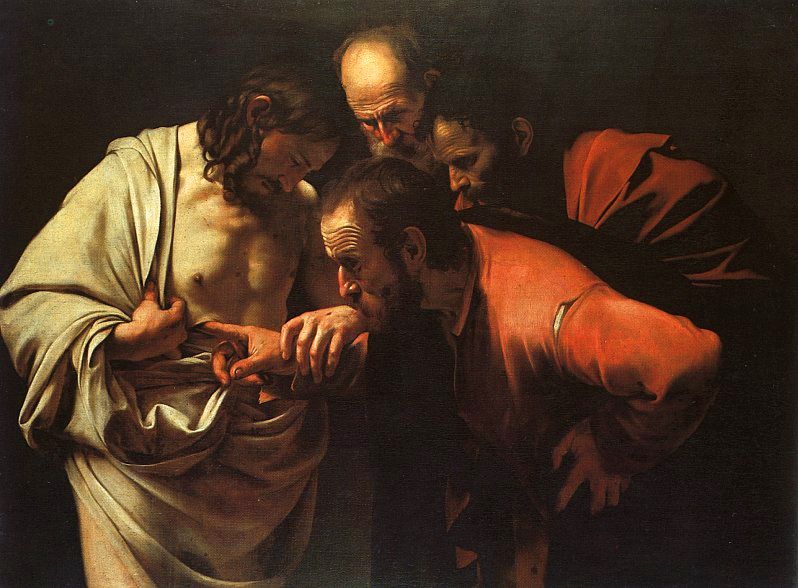
(Gospel Reading: John 20.19–31)
“The man of faith who has never
experienced doubt is not a man of faith.”
This is a tale of two Thomases. “Doubting Thomas” is the way one of the
disciples in today’s Gospel reading is often unjustly described – as if we
think we can write him off for his temerity in questioning the disciples’
account of their Easter meeting with Jesus. The other Thomas is the man who wrote those words with which I began:
“The man of faith who has never experienced doubt is not a man of faith.”
This Thomas is a writer I’ve kept going back to throughout the time I’ve
been ordained - over 30 years. Thomas
Merton was one of the great Christian writers of the 20th
century. Like many people, I first encountered his work in his book “The Seven
Storey Mountain.” It’s the account of his vocation – from his childhood
upbringing in France and England, through the loss of both his parents, his
move to America, and his coming to faith... which led him to become a Trappist
monk. He realised, as he says in his book, that his vocation – any Christian’s vocation - was to be a saint, and the book ends on a
high note with a great confession of faith and his profession into monastic
vows. It’s a tremendous book of 400 pages telling how God has been there all
along, seeking him out and calling him on his journey of faith.
But what becomes still more interesting
is to see how he went on from that
high point. Could he continue living at that level of faith and confidence? There’s
a lot to learn from reading his personal journals. Just a few years after the
runaway success of “The Seven Storey Mountain”, he finds himself correcting the
proofs of the book’s translation into French. It had become one of the
religious bestsellers of all time, but he admits that now the book leaves him
quite cold – he is no longer the man who wrote that book. Or rather, we might
say, he’d moved on. Faith cannot remain
static, so a faith which is full of confidence will – if it’s going to be a
living faith – have to be challenged, even questioned and doubted.
“The Seven Storey Mountain” remains a
classic of Christian spirituality. But it didn’t deal with those parts of
Merton’s life that his superiors thought unedifying. A rather wayward year as
an undergraduate in Cambridge, for example. And it’s never been established
whether during that year he had fathered a child with whom he then had no
further contact, a child later killed with its Mother during the Blitz.
Whatever the truth behind all the speculation, we know that beneath his desire
for holiness, and the zealous faith of his best-selling book, there were
private doubts, anxieties, questioning and griefs.
And this is something that comes out
clearly for the first time with the publishing of his personal journals. Having renounced the world, taken his vows in a
silent order, after getting special permission to live in his own hermitage in
the woods, Merton at the age of 50 had to have surgery on his spine which
required that he leave the monastery. The operation was a success, and he
returned to the abbey just in time for Easter – only for it to dawn upon him in
the days that followed that he had fallen in love. It was a student nurse who
had cared for him only briefly, but his feelings forced him to conclude, “I
will do the only thing possible and risk loving with Christ’s love when there
is so obvious a need for it.” He knows that his vows and his security in the
religious life require him to break off his contact with the nurse. But
everything he felt he had under control is now called into question. Recklessly
he calls her from the monastery and arranges meetings with her – and knowing
their feelings for each other, he comes to understand himself the more deeply. As he writes in his Journal: “One of the
good sane things about this love is seeing myself as I am loved by M. True, she
idealizes me impossibly, yet at the same time I am unavoidably known to her as I am. Many of the things she loves in
me are things I find humiliating and impossible, but she loves them because
they are concretely mine. I love her the same way....”
In a sense it is a hopeless love affair.
It’s not something Merton can continue while maintaining the integrity of his
vows - nor in fairness to the young woman. But it’s also something deeply
moving, something that enables him more than anything in the last years of his
life to grow – and that finally allows him to make sense of his vocation.
I tell the story because it shows that faith is not something we can insist upon.
We cannot impose our faith upon other people, and we cannot maintain it for
ourselves simply by keeping the rules. We can only live out the life of faith
by recognising our humanity, by allowing questions and doubts to reach our
hearts and minds – and above all by letting love do its work. In the end for
Merton there is no conflict between his monastic vocation and the call to love
– and to love with all his human
being. Because when he is able to accept finally that someone else is loving
him as the person he is – rather than
as a monk, a priest or a writer – he comes to understand truly what love is.
It’s a lesson which has had to be learned
over and over again from the earliest of times by anyone who would be a
follower of Christ. The apostle Thomas
is not someone to be condemned for his failure to believe that Christ was risen
from the dead. Perhaps he was a man of stubbornness, someone who just wouldn’t
take other people at their word – he tells us that much himself: “Unless I
see.... I will not believe.” But can we not feel for him too? The other
disciples have a message they can proclaim with boldness, because they have seen for themselves that first Easter day,
when Jesus had come to them through the locked doors. But he had missed it – how is Thomas ever to be
able to join with the other apostles in proclaiming their message of the
Resurrection when he hasn’t seen it the same way they have?
And I want to ask, isn’t there a message
for us all here, when we are trying to bear witness to the faith which keeps us
going? We need to be confident in our faith, but we need to see that our
experience is not necessarily that of other people. What is convincing to us may
mean nothing to other people. Have they been there with us in our experience?
Have we gone through the same experiences as them?
Of course St. John’s Gospel gives us a “happy
ending” for Thomas despite all his questioning when Jesus comes a week later to
stand again in the midst of the disciples. But what strikes me is that though
Jesus shows the wounds in his hands and side to Thomas and invites him to touch
them, we’re not told that Thomas does in
fact do so. “My Lord and my God!” says Thomas to Jesus, but there is no
longer the need for him to have tangible proof. “Blessed are those who have not
seen and yet have come to believe,” says Jesus. And the truth of Thomas’s
conversion is not that he can now reach out and touch the wounds of the risen
Christ, but that the risen Christ has reached out and touched him. Jesus comes to Thomas with all his
doubts and questions. He lets him ask, he allows for his anxieties, and still
he calls him his disciple. Failure to believe is not grounds for condemnation.
And the way to faith for Thomas is through the love of God in Christ in
accepting him in all the frailty of his humanity.
The other Thomas – Thomas Merton – had
embarked upon his Christian journey and his monastic vocation with the highest
of goals, but was to discover the true meaning of love only when he found
someone who loved him outside the
rules and boundaries he’d set himself, someone who loved him as and for himself. That’s the way that
God loves us, and the way he calls us
into a community where we love one another. As Merton records: “I dreamt I was
telling several other monks, ‘I shall be a saint’, and they did not seem to
question me. Furthermore, I believed it myself. If I do – I shall – it will be
because of the prayers of other people who, though they are better than I am,
still want me to pray for them.”


Wednesday, 27 March 2013
Triduum at St. Cuthbert's - the Great Three Days
Thursday MAUNDY THURSDAY
28th March 7.30p.m. Sung
Eucharist of the Last Supper followed by a Watch of the Passion.
Friday GOOD FRIDAY
29th March 10.00a.m. At
the Cross – All-age Service
2.00p.m. Liturgy of the Day
with Holy Communion.
Sunday EASTER
DAY - THE DAY OF RESURRECTION!
31st March
10.30a.m. Sung Parish Eucharist
with Easter Ceremonies
and Renewal of Baptism Vows
Please take the opportunity to make the most of
Holy Week!
Sunday, 10 February 2013
Transfigured humanity - glory in weakness
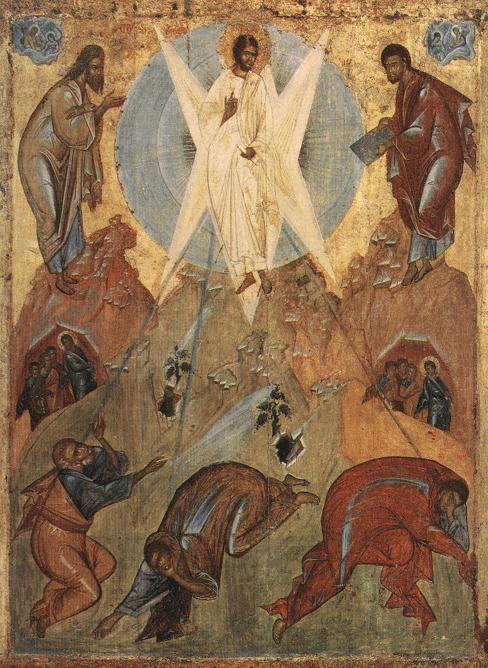
Here’s a verse from today’s Gospel reading (Luke 9.28-36):
Peter
and his companions were weighed down with sleep; but since they had stayed
awake, they saw his glory and the two men who stood with him.
It’s only St. Luke who tells us that when the
disciples went up a hill for the purpose of prayer, they were really too tired
to do the job. But while he is praying, Jesus is transfigured in their midst;
the appearance of his face changes and his clothes become dazzling white, and
Moses and Elijah appear to bear witness to the glory of God revealed in Christ.
The glory of God is a man
fully alive.
We need to go back to those words of St. Irenaeus
which I quoted: “The glory of God is a man fully alive.” That’s what we see in
Jesus - the Son of God, but at the same time fully human. The glory of his
Transfiguration is not something alien coming upon him. The Transfiguration of
Christ reveals the true glory, the real nature of a man who some want to write
off as “all too human.” Our humanity is a calling to share the glory of God.
Our weakness is something to be transfigured. God can use us because we are human.
Glory is not something to escape into from our
human condition. Glory is revealed because we are human with all the frailty
and frustrations of being what we are. But we wrestle with the frailty and
frustration. (Here) at St. Cuthbert’s this morning we can’t help but be
conscious of the loss we share by the death of Ian Severs on Friday evening. I
wonder what people who didn’t know Ian made of him when they first met him?
They’d find him in a wheelchair. With his Parkinson’s
the words didn’t always come out right, limbs didn’t always behave
properly; and he’d lost a leg - and had an arm that was barely functioning. You
needed to get to know Ian a bit to start to know the man - and to recognise
just how important he’s been, not only to the members of his family, not only to
his friends, but to us as a church, and more widely in showing what it is to be
fully alive even in the most extreme conditions of physical weakness and
disability. He was with us (here) in church at the Eucharist last Sunday. In
the conversations I had with him during the last week he didn’t say that he’d
been feeling unwell; he did say he’d
had a positive outcome from his last hospital check-up - but mainly he was
taken up with tackling problems of fabric we’re having at present in the church
and the hall. Problems they are to us - but Ian’s approach was to sort them
out.
Today our Diocese of Durham is encouraging us to
observe as “Giving Sunday.” It’s up to the parishes as to what they do with the
occasion - and it’s not the best time of year, I think, to be trying a
stewardship drive… to encourage people to put more money on the plate, or think
about increasing their standing order
for the church, or review the Gift Aids they might use to make their giving
more tax efficient. Of course we’d be delighted if you do all these things. But perhaps we need first to think of life as
a gift - in all that we receive from God, in the extent of God’s mercy, in the
generosity to which we are called as Christians to respond, in what we can give
back. It’s a time to express gratitude. I and the Church Council need to say thank you to all of you who give to
support the work of our church. I don’t need to say how much you should give. I realise that some people
get concerned about what they can
give. What I’d say now is that our giving is about recognising the gift we have
already received. As to the extent of our giving, it’s a strange thing but
people who are generous somehow find themselves able to go on being more and
more generous. Love itself does not count the cost.
I’m pretty hopeless at thinking of how to conduct
so-called “stewardship campaigns” to stimulate giving to the church - I’m not
starting a campaign now. But when we’ve had them in the past (at St.
Cuthbert’s), I’ve been glad for people who have been practical about what we
needed to do and who were ready to take a lead. One of those people was Ian
Severs. It was Ian who was ready to get
up in front of other people and tell them what we needed to be doing. He put
into practice what we needed as an example. He was down to earth.
And that’s when we see that the “glory of God” is
not something unworldly. It’s worked out in the here and now, within the limits
of our human capability, but at the same time able to be transformed - transfigured.
For all we have received - in terms of wealth,
health (and our weaknesses), material resources, and above all people who show us his grace at work, in
whom his glory is revealed, thanks be to God!
Sunday, 3 February 2013
Candlemas - light in darkness is more than processions with candles
Here are
some words which are perhaps difficult to take in at first hearing, but they
bear thinking about:
As we share our lives with the powerless, we
are obliged to leave behind our theories about the world, our dreams and our beautiful
thoughts about God to become grounded in a reality that can be quite harsh.
That is where we meet God, God who is Emmanuel, God-with-us. There God is
present, hidden in wounded humanity, hidden in the pain of our own hearts.
The writer of these words is Jean Vanier who founded the
community known as L’Arche. He came
from a background of privilege. He was born in Geneva while his father was on
diplomatic service. His father became Governor General of Canada. He himself
served in the Royal Navy for several years from the end of the Second World
War, but he left to study philosophy in Paris where he gained his doctorate.
Returning to Canada he taught and became a Professor. He had privilege, education,
intellect and ability - everything you could want, you might say.
But something was lacking. He became aware of the needs
of people with disabilities - especially learning disabilities - people in
their thousands who had become institutionalised, the passive recipients of
whatever care might be given to them. And he recognised a perception that
people with such disabilities had nothing to give - they could only be cared
for. It was a perception that Vanier believed needed to be challenged. In 1964
he invited two men with disabilities to join him in sharing his home. In 1969
the first of the communities of L’Arche was established in Canada. The first
community in the UK was set up in 1973. And now it exists in over 40 countries.
There are 137 communities with over 5,000 members.
L’Arche is more
than a success story in terms of its growth and membership. It’s what lies at its heart that is so important: the
equal membership of people with and without disabilities; the recognition of
what each member might bring; cooperation with individuals and agencies which
bring professional expertise; a grounding in Christian faith, but a faith which
is respectful of other traditions. And I’m struck by those words with which I
began which sum up the whole outlook of its founder: about the sharing of our
lives with the powerless; about the need to leave behind our theories of the
world; about recognising that faith in God is more than a matter of beautiful
thoughts but is grounded in what might often be harsh realities.
The words I’ve quoted come from a book which Jean Vanier
has just published. When I checked out his biography I discovered that he was
born in September 1928. He’s 84 - just a month older than my mother, 11 months
younger than my father. Jean Vanier has dedicated the last 50 years of his life
to living and working with people who have disabilities - people who might
easily be written off. I think I need to know more of what has sustained him -
perhaps to read this latest book and not just the snippet I’ve found and
quoted.
I’m encouraged that he’s still going strong at 84. And notice that one of the
characters in today’s Gospel reading is 84 - Anna, a “prophet,” who recognises
in the child Jesus something special which impels her to praise God and tell
everyone about this baby which Mary and Joseph have brought to the Temple.
Simeon - another godly man whom we encounter in the same story - is also
traditionally thought of as old:
“It had
been revealed to him by the Holy Spirit that he would not see death before he
had seen the Lord’s Messiah.”
That’s what St. Luke tells us - it seems that death could
not be far away for Simeon, and having looked upon Jesus he says that he is
ready to die. A life’s work has been fulfilled because God has revealed his
salvation in the Christ-child, so - “Lord, now lettest thou thy servant depart
in peace,” as the prayer book translates Simeon’s words.
I’ve wrestled with this reading for today. Here are old
Simeon and Anna - and they are fulfilled. They are elderly, but still about
their work, still full of hope, still attuned to God and ready to hear what he
is saying.
My mother - at the age of 84 - has just managed to get
back to services in her church during the last couple of weeks after some
months away. She is a person of faith, sustained throughout her life by that
faith, putting it into practice, perhaps rather too dogged in her determination
to do the things she thinks are right. She’s back in church because she is free
to get there now that she’s no longer able to care for my father at home. We’re
praying for my father in our church at present amongst those who are in need of
healing - but I know that physically it’s not going to happen. And there is
life’s cruelty - my mother able to carry on, like old Simeon in the Gospel
story, like Anna and Jean Vanier who are also 84. But it takes two people to
get my father out of a chair. A stroke, blindness and deafness have taken their
toll over the years, an arm is now quite useless, incontinence and depression
are a fact of his life. Everything points to a still further deterioration that
could drag on for who knows how long. And I have to ask myself, where is the
good news in that? - where is he to find hope? - what sort of meaning does this
have?
I’m grateful for those who ask me how my parents are
managing. I’m sorry that sometimes I can’t say much more than it’s all quite
horrible. It’s a rather inarticulate response. T. S. Eliot puts it rather
better in his meditation, “A Song for Simeon:”
My life is
light, waiting for the death wind,
Like a feather on the back of my hand.
Dust in sunlight and memory in corners
Wait for the wind that chills towards the dead land.
Like a feather on the back of my hand.
Dust in sunlight and memory in corners
Wait for the wind that chills towards the dead land.
Perhaps Simeon knows all too well his frailty and the
nearness of death. For Jean Vanier it is an important thing not to live with
false illusions, to recognise harsh reality - but there to find God.
“This is where we meet God…” Vanier realised. In lives
shared with people who are quite powerless, who might easily be written off,
who are dismissed as having nothing to offer. He’s “hidden in wounded humanity…
in the pain of our own hearts.”
And he’s called “Emmanuel,” which means God-with-us.
That’s why we celebrate today’s Feast of the Presentation of Christ in the
Temple. Because these two old people, Simeon and Anna, so near the end of life
encounter this family of Mary, Joseph and a 40-day old child who can do nothing
for himself. And in this child they see God’s purpose revealed. Jesus himself
comes as one who is quite powerless, entirely dependent on the care of others -
“the Word without a word,” but one who speaks to us because he is God sharing
the fullness of humanity, declaring it in life and joy, affirming it even in
brokenness and death.
This is today's Homily, preached at St. Cuthbert's, Benfieldside and St. John's, Castleside. The Gospel Reading was Luke
2.22-40. The Homily can be found as a download if you click here.
Subscribe to:
Posts (Atom)